

The first videos came in grainy and sudden. People running under a freeway overpass, their silhouettes stuttering like bad animation. Behind them: the red and blue flicker of cruisers, a fast blur of shouting, some kind of projectile bouncing off concrete. You’ve seen it before, probably. Another protest. Another night. But this time, it’s Los Angeles, and it’s not a slow boil. It’s a rupture.
It started, officially, with ICE. Early morning raids swept through neighborhoods like ghost nets, pulling people from homes, sidewalks, a bakery in Boyle Heights. The language in the press releases, “targeted enforcement,” “criminal detainers,” had the sharp, technical edge of something meant to sound responsible. But people on the ground knew better. It didn’t feel targeted. It felt like a dragnet. Whole families disappeared. Schools half-empty by lunch.
Then came the protest, and then came the state.
By Saturday night, the 101 Freeway was shut down by a wall of human bodies. Not in chaos, but in something that looked an awful lot like strategy, with lines of demonstrators locking arms, chanting in English and Spanish. Police in riot gear moved in like weather. Tear gas. Rubber bullets. The familiar machinery of crowd control, humming into gear.
On The View, Sunny Hostin said, “There is no crisis in Los Angeles that ICE did not cause.” A clean diagnosis. Not just of the raids, but of the state’s allergic reaction to dissent.
What followed was the same playbook, just louder; troops flown in from Pendleton, Humvees on Sunset Boulevard, Marines stationed outside City Hall. President Trump described the protests as an “organized riot” and said the city was “under siege.” FBI Director Patel called the demonstrators “marauding criminals,” language more at home in a medieval fantasy novel than a democratic republic.
All of this was predictable. What wasn’t predictable was how ordinary it began to feel. Watching federal troops roll into a city known for its dreams and disasters felt... boring. That’s the real horror, isn’t it? That the militarization of American life now feels like reruns. The kind of news you scroll past because you assume the outcome is already written.
But here’s the thing: the violence that breaks glass is not the most dangerous kind.
That kind, the explosive kind, the kind you can film and tweet and blame, is always loudest. It’s also the easiest to condemn. What’s harder to see is the violence that hides behind policy and paperwork. The kind that closes schools, deports parents, redlines neighborhoods. The kind that tells you your labor is welcome, but your life is not. That violence doesn’t explode. It accumulates. It builds up in silence, in courtrooms and council meetings and late-night detentions. And then one day, it catches fire.
Philosophers sometimes call this systemic violence, the kind built into the ordinary. It is violence that doesn't need a weapon, because it has rules, forms, and signatures instead. It's not declared. It’s administered.
Most of the protests were peaceful. That’s not a footnote. It’s a feature. But if you only read the headlines, you’d think LA had descended into something feral. “Riots.” “Lawlessness.” “Crisis.” The media loves a burning trash can. It photographs well. It speaks to fear. And fear gets clicks.
But behind the fear is something rawer, something closer to truth. A protester interviewed by The Washington Post put it plainly: “We’re not here to destroy. We’re here because we’ve been erased.”
Think about that. Erasure. Not attacked. Not debated. Not disagreed with. Erased. That’s the quiet violence. The systemic kind. And when people feel like they no longer exist inside the social contract, the only way to be seen is to step outside of it.
This is where theory helps us. In culture, we’re told everything is working as long as nothing looks broken. But philosophers like Foucault warned us: sometimes the quietest systems are the most controlling. Sometimes what seems like “order” is just domination with better lighting.
What’s remarkable is how quickly the city’s leadership tried to push the narrative back into place. Governor Newsom filed a lawsuit claiming the federal presence was unconstitutional. Mayor Bass told reporters the troops were “escalating tensions.” And maybe they were. But that doesn’t undo the fact that, for many Angelenos, the escalation came long before the Marines ever showed up. The escalation is in the air. It’s structural. It’s historical.
This isn’t a defense of riots. It’s a rejection of shallow narratives.
We have to stop asking whether the protest is “justified” and start asking what produced it. What kind of system makes a freeway shutdown feel like the only available speech? What kind of governance responds to a call for dignity with flashbangs and troop convoys?
The answer, if we’re being honest, isn’t complicated. It’s just uncomfortable. It’s easier to shame the smoke than investigate the fire. It’s easier to blame the broken window than ask what it was keeping out.
So here we are. LA, again. A city that has always burned in its own mythology, now burning in real time. But maybe this isn’t just about ICE, or even about LA. Maybe this is the latest chapter in a much longer book, one written in eviction notices, deportation memos, budget cuts, and late-night knocks on the door.
The protests will die down. The headlines will shift. But the question will remain: if this is how a city reacts to the pain of its people, what kind of peace are we trying to protect?
The Apparatus and the Uniform
Let’s zoom out now. Because what happened in LA wasn’t just a local story. It was a performance; a loud, tactical reminder of who holds the monopoly on force in this country, and how that monopoly is enforced.
This is where the uniform comes in. The helmet. The Humvee. The sound of boots on downtown pavement. It’s more than intimidation. It’s not just about quelling unrest. It’s about displaying control. About reminding a restless public that power doesn’t just act, it shows itself acting.
Political theorists have long argued that the modern state survives not because it is just, but because it is persuasive. Not through laws alone, but through rituals: badges, barricades, press briefings, and yes, tanks in cities. These aren’t just responses. They’re symbols.
That’s how a state apparatus works. It isn’t just cops and courts and cages. It’s the choreography of discipline. The silent agreement that some bodies can be moved, detained, surveilled, and erased without due process, and that others will call that justice.
To the people defending the military deployment, the logic seems simple. The law was broken. The peace was disrupted. The troops restored order. But “order” is a loaded word. You can order a protest into silence. You can order a neighborhood to go home. But you can’t order justice into existence.
What made Trump’s response so stark wasn’t the use of the military itself, although that would have once been unthinkable. It was how seamless it was. How quickly the language of national defense got mapped onto a domestic street protest. How federal muscle slid into a city already bruised by inequality.
The real shift didn’t happen with the flashbangs. It happened the moment the protest was reframed not as grief or outrage or resistance, but as enemy action. From there, everything becomes justifiable. Once you declare a crowd a threat, you don’t have to listen. You only have to neutralize.
And once a city becomes a theater for military performance, the people in that city become actors too, cast as looters, agitators, terrorists, illegals. The plot is written in advance. All that’s left is the execution.
This isn’t the edge of authoritarianism. This is its dress rehearsal. And the applause is already rolling in from those who mistake force for strength and obedience for peace.
But it bears repeating: what erupted in Los Angeles wasn’t a glitch in the system. It was the system flashing its code. And the people in the streets? They weren’t trying to burn the city down. They were trying to write themselves back into the story.
They still are.
And Still the Birds Sing
Maybe this ends quietly, with the cleanup. Barricades hauled away. Graffiti scrubbed off brick. The last news truck driving off. A moment that gets tucked into a folder marked “June.”
But maybe it also ends with something softer. A question that lingers in the back of the mind while walking through the neighborhood. A look exchanged on the train. A realization that what felt like an explosion was actually a message. That this wasn’t madness or mayhem. That it was something else: a reminder. That even amid helicopters, sirens, and blinding lights, people still put their feet on pavement and demanded to be counted.
And isn’t that, somehow, a form of hope?
Because even in the smoke, there were hands reaching out. Even under the roar, there were voices calling names. Even in the cold choreography of force, something warm kept rising.
You could hear it if you listened closely. Somewhere in the distance, under the noise of it all, a bird still singing in a broken city.
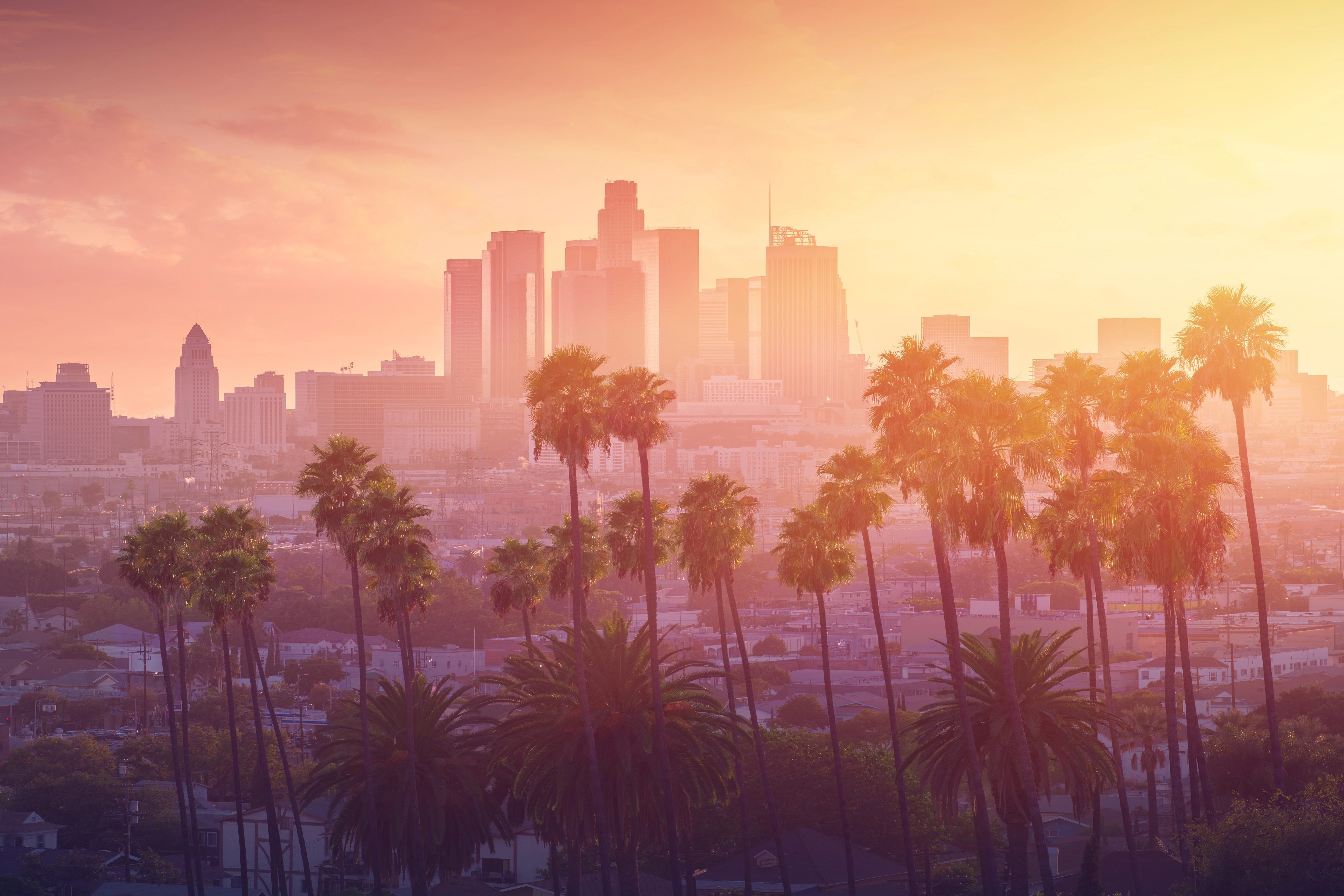
Photo Credit: Los Angeles hot sunset view with palm tree and downtown in background, California, USA via Depositphotos (user Gozha Net), image ID 131462382.