

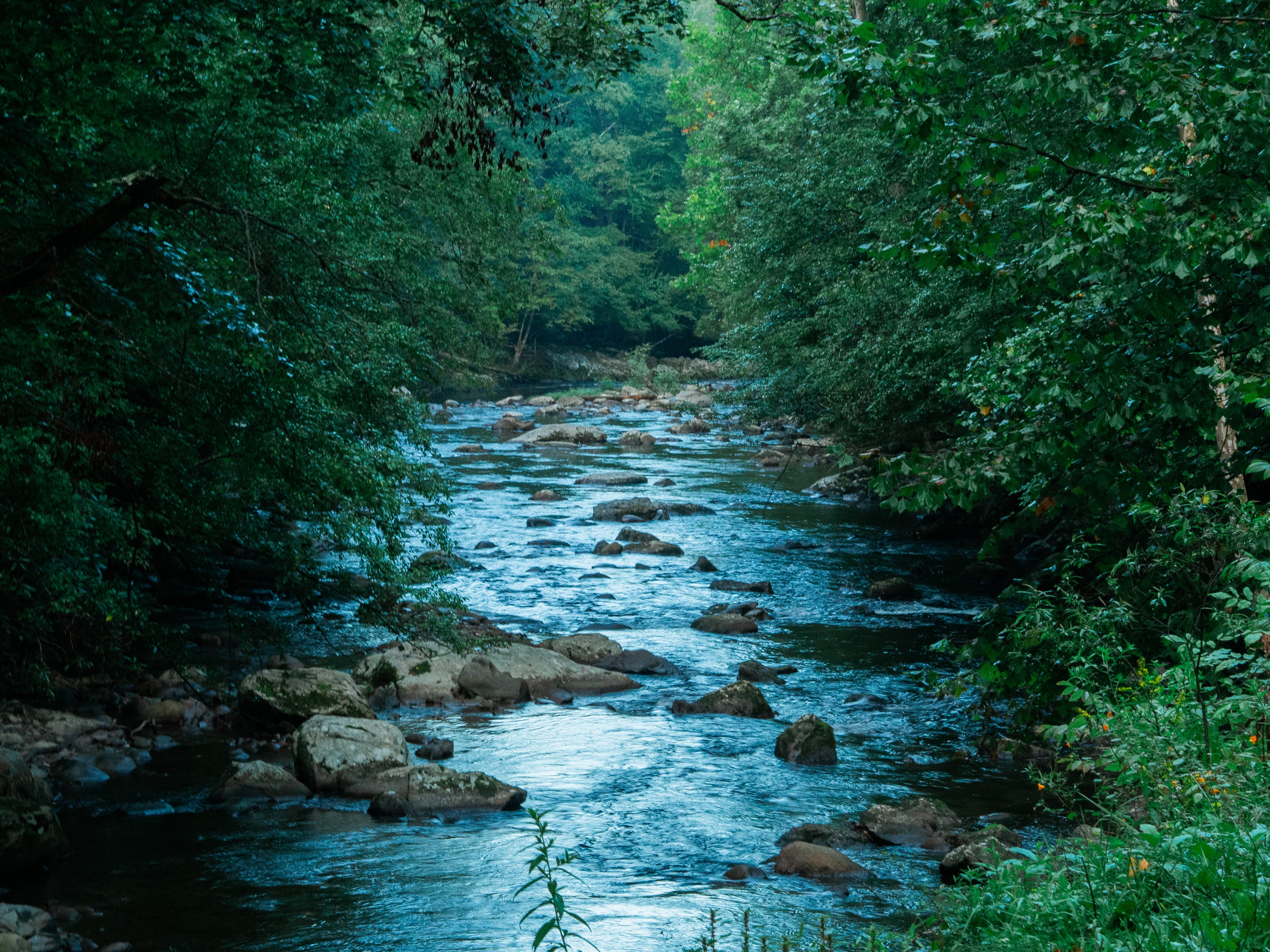
© Eric Chapman. All rights reserved. Image: Smoky Mountain River. Use or reproduction without permission is prohibited.
When I was a boy, I leaned against the old walnut tree in the yard of my childhood home. I’d press my back to its rough, furrowed bark, eyes closed, listening. The world around me spun out its symphony: wind threading through leaves, the dry creak of branches shifting in the sun, and below, the quiet breath of roots pushing deeper into the earth. I believed then, as I do now, that this walnut tree held secrets.
Beneath the ground, roots wove an unseen web, connecting the walnut tree to others around it, part of what we now call the mycorrhizal network. Scientists speak of it as a communication system, a network where trees share resources and warnings, but even this telling falls short. Words like “network” and “communicate” are too small to capture the silent, endless exchange that happens below. The Diamond Sutra, one of the most treasured teachings in Mahayana Buddhism, comes to mind here. “All phenomena are like a dream, an illusion, a bubble, a shadow,” it says. The walnut tree, with its roots intertwined in the dark, defied the weight of language and naming. It simply was.
In the years since, I’ve felt drawn to trees wherever I’ve lived, their forms different yet resonant with that same wordless truth. Outside my window now, a beautiful Norwegian maple stands, its branches wide and open to the sky. One summer storm, I watched as rain began to fall, cascading from low, bruised clouds in heavy, steady drops. The maple’s leaves quivered, drinking deeply, and I imagined the roots below, reaching and unfurling, passing the rain into the dark.
The rain wasn’t simply a relief to the earth; it was a pulse of life, given without signs, without reliance on form or expectation. The maple held its share and sent the excess through the network — a subtle, wordless gesture. A younger tree nearby, slender and thirsty, absorbed the offering. There were no signs exchanged, no transactions measured, only the silent flow of being between them. This was not kindness, not survival as we know it, but the spirit described in the Diamond Sutra: a generosity that does not rely on any object or form. The ground itself seemed to hum with this unmarked, unclaimed giving.
As the rain pooled at the base of the maple and trickled into the soil, I watched it drawn deep into the roots’ labyrinth. The clouds loosened their grip and drifted on, satisfied in their work. The exchange was never a transaction or a gift as we would define it; it was simply the way of things, like the tides, like the cycle of wind. Here was the generosity of the bodhisattva, practiced without reliance on signs, objects, or recognition. No words, no labels, just the seamless, wordless knowing.
Later, in the calm that followed, the maple’s branches glistened with the last drops of rain, catching the soft light. I thought of that walnut tree, how I’d watched it after storms, the smell of wet bark sharp and earthy through the open window. It never spoke, never gave lessons in a human voice. But it showed me, through silence, how the world gave and received in a continuous, boundless cycle.
Even now, when I see that maple outside my window, I understand it is no lone sentinel. It is part of something vast, breathing, and interconnected — the ground, the sky, the roots below, and the rain that moves between them. Here, the Diamond Sutra whispers in its paradoxes: “He does not rely on any object,” for true generosity is beyond forms, beyond words. Everything exists in a flow that precedes and outlasts any name we might give it, bound together in that quiet, unseen web.