

Updated slightly: September 15, 2025.
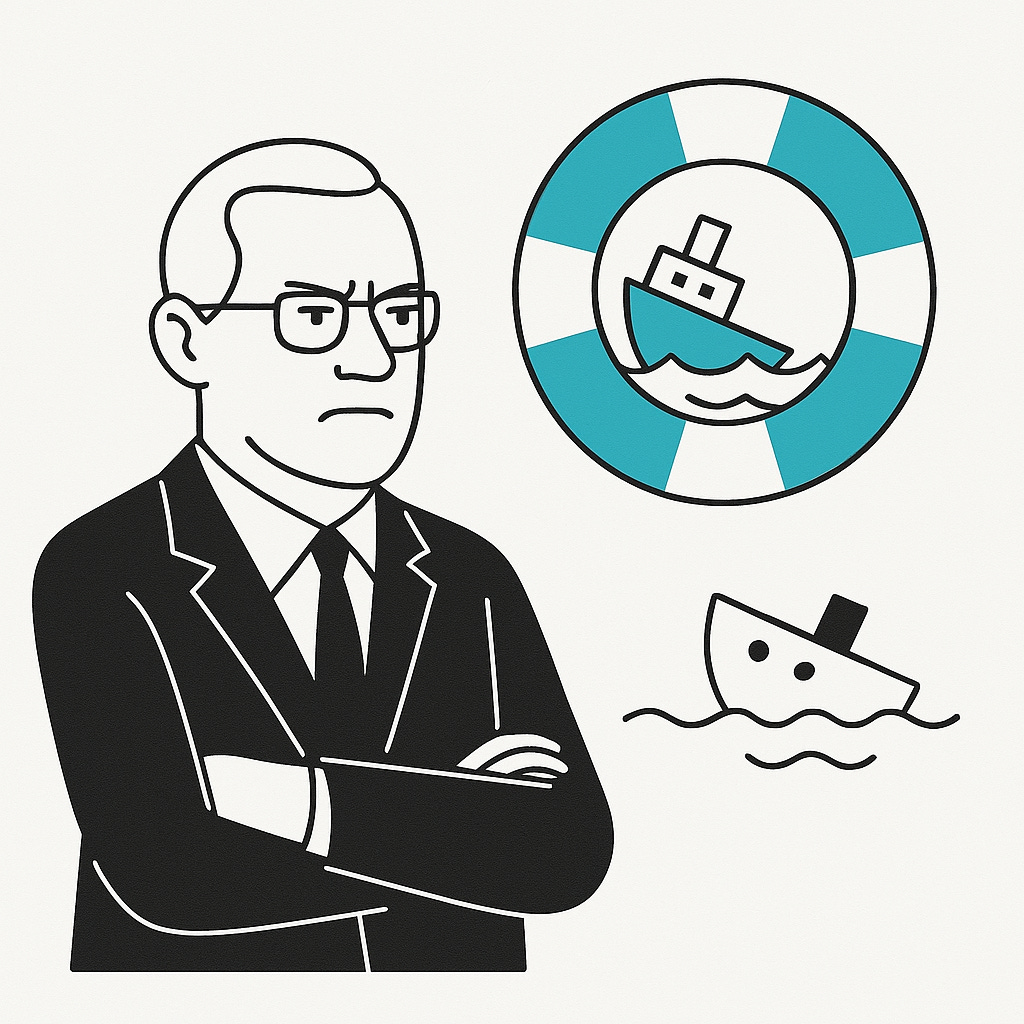
Modern conservatism likes to imagine itself as the last adult in the room, buttoned-up, tradition-bound, and clinging to objective truth like it’s the final lifeboat on a sinking Titanic of cultural decay. At the heart of this self-concept is a loud, repeated rejection of postmodernism, that amorphous philosophical scapegoat accused of dismantling meaning, authority, and Western Civilization, usually before lunch.
To hear its critics tell it, postmodernism is less a school of thought and more a slow-rolling apocalypse. Jordan Peterson has deemed it a “catastrophe,” citing its supposed inability to distinguish competence from raw power. Ben Shapiro routinely uses it as shorthand for feelings-over-facts hysteria. And Roger Scruton, never one to understate, called it “the suicide of thought.” For this corner of the right, postmodernism is the big bad, it’s chaos in a turtleneck, nihilism with tenure.
And yet, here’s the twist worthy of a postmodern novel: modern conservatism has not only entered the haunted house of postmodernism, it’s redecorated and started charging admission.
Nowhere is this contradiction more vivid than in what sociologist Ulrich Beck dubbed the “risk society.” In this model, the primary threats we face aren’t biblical plagues or angry deities, they’re entirely man-made. Think: climate change, global economic chaos, and diseases that turn grocery stores into war zones. These risks are opaque, complex, and have consequences that stretch far beyond the electoral cycle. But instead of responding with the sobered caution one might expect from a so-called party of prudence, conservatives increasingly choose denial, or worse, weaponized uncertainty.
Take climate change. The science is in. It’s loud, peer-reviewed, and wearing a neon vest. But the conservative playbook has been to slap a red hat on the issue and call it fake news. Remember when Donald Trump claimed global warming was “created by and for the Chinese”? That wasn’t policy, it was performance art. Tucker Carlson, not to be outdone, called it a “religion,” thereby elevating vibes over verified data.
This brand of denialism isn’t just stubborn; it’s postmodern to the bone. Dismissing empirical consensus as a leftist narrative isn’t fighting relativism, it’s reenacting it with a patriotic soundtrack. And so, in a supreme act of ideological cosplay, the right mimics the very thing it claims to abhor: a flexible relationship with truth, a preference for perception over reality, and a deep mistrust of institutional knowledge.
The same plotline played out in Trump’s trade war with China. Nearly every credible economist, yes, even the ones with GOP punch cards, warned against it. But Trump forged ahead, explaining that “trade wars are good, and easy to win.” That’s not an economic strategy; that’s a slogan. The tariffs became less about global markets and more about flexing on imaginary adversaries. Narrative triumphed over nuance. Symbol over substance. It wasn’t economic policy, it was myth-making.
COVID-19 only tightened the feedback loop. As the virus spread, many conservative leaders defaulted to minimization and deflection. Lockdowns were tyranny. Masks were overreach. Public health officials became the new villain class. Senator Rand Paul crystallized this distrust with a line that could’ve been ripped from a Derrida lecture: “We shouldn’t presume that a group of experts somehow knows what’s best.” And just like that, we’re back in the postmodern sandbox, where all authority is suspect and every reality is up for grabs.
The results? Fragmented worlds. One reality wears masks; another burns them. One trusts vaccines; the other shares memes about microchips. And underneath it all is a shared operating system of doubt, spectacle, and selective truth. If this feels familiar, it’s because Baudrillard mapped it out years ago. We’re living in hyperreality now, where red hats carry more meaning than legislation, and digital trolling carries more weight than debate.
Online, the aesthetic turns surreal. Right-wing memes, conspiracies, and culture jamming don’t just resemble postmodern media, they are postmodern media. QAnon, with its cryptic symbols and interpretive rabbit holes, operates more like an alternate reality game than a political movement. It rewards not belief, but participation. It’s not ideology, it’s immersion.
And here lies the final irony: while conservatives publicly sneer at relativism, they’ve constructed entire ecosystems where truth is whatever the tribe decides it is. Institutions are hollowed out. Expertise is ridiculed. Moral clarity is traded for aesthetic dominance. This isn’t a rejection of postmodernism. It’s a masterclass in its application.
Beck called it reflexive modernity, a world where we invent the risks and then mismanage them in real time. That’s where we are now: cycling through disasters of our own making while using nostalgia as a GPS. Except the map is upside down and we’re arguing about whether maps are real.
What passes for conservatism today isn’t conserving anything, not tradition, not nature, not institutional wisdom. It’s not even trying. What we have instead is a reactive performance, uncertainty as strategy, disruption as identity, risk as ritual. And the joke (which isn’t funny) is that this evolution isn’t a glitch. It’s the feature. The right didn’t just get infected by postmodernism, it figured out how to make it dance.
This isn’t hypocrisy. It’s metamorphosis.
Or as Nietzsche might’ve put it (if he had a Twitter account): stare into postmodernism long enough, and eventually, it starts retweeting you.