

Nobody takes anything on faith anymore, and we are proud of this.
We check. We read the reviews before we trust the restaurant and the study before we trust the doctor, and we would like to see the Great Pumpkin’s documentation before we commit a Halloween to him.
We still believe plenty. In markets, in melatonin, in the taco place with four thousand reviews. What we no longer do is believe without receipts.
This passes for maturity. But a belief that has been fully verified is not a belief anymore. It is information wearing a hat. All that checking has made us accurate without making us certain, and the more we can confirm, the less willing we seem to be to commit to anything we can’t.
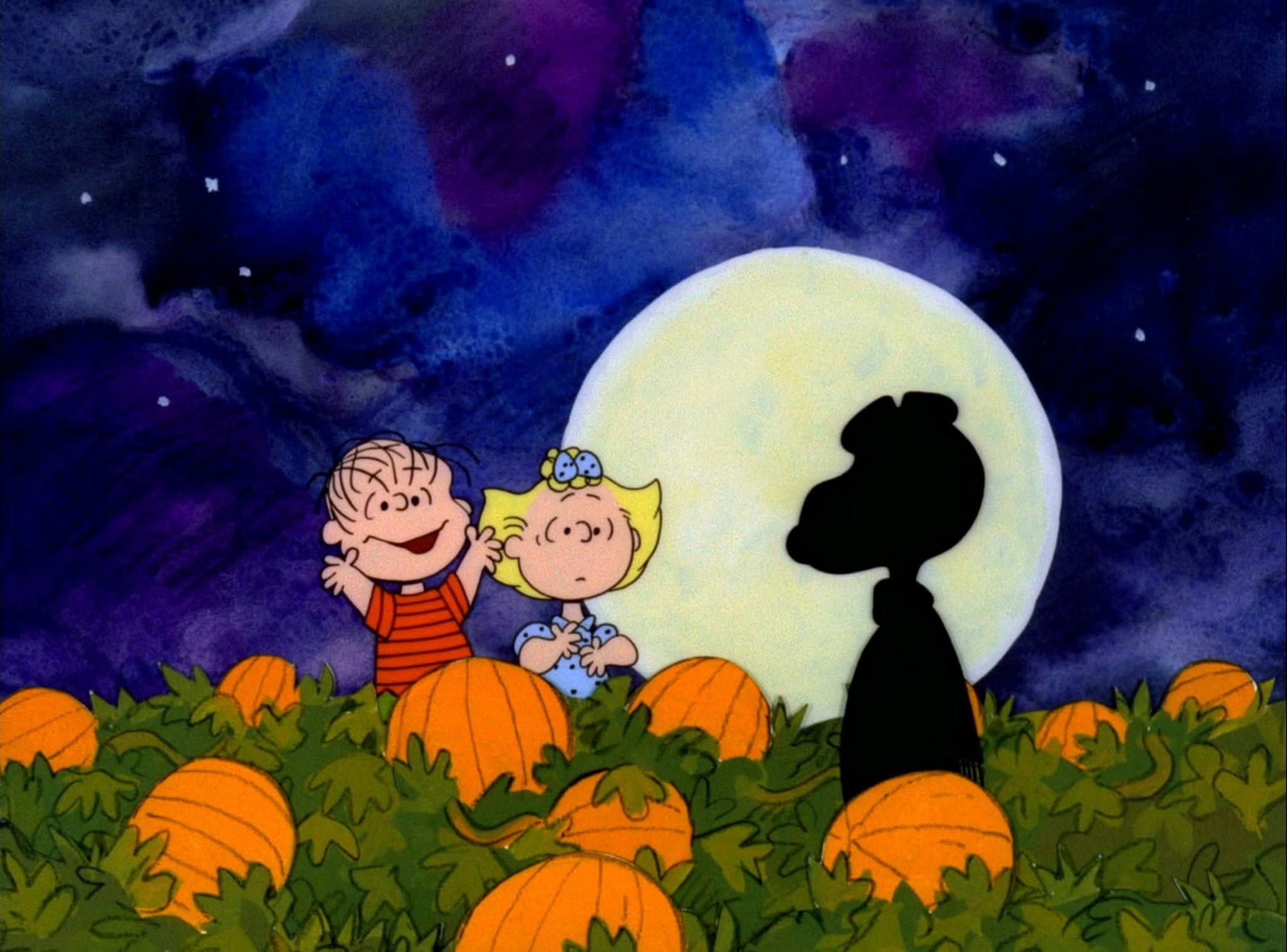
I have been compared to Linus van Pelt more than once, and I have decided to take it as a compliment, which is what you do with a comparison you can’t shake.
Linus is the kid with the blanket. He is also the kid who walks to center stage in the Christmas special and recites Luke from memory, and the kid who, whenever Charlie Brown is spiraling into one of his low-grade existential crises, says the sane thing. He is the strip’s resident philosopher, its only functioning adult, and he is eight.
He is also the kid in the pumpkin patch.
It took me an embarrassing number of Octobers to see that Schulz did this on purpose. The same child who knows what Christmas is all about spends Halloween night in a field waiting for a squash deity. The wisest kid in the strip holds the dumbest belief in the strip.
That is not a contradiction. The capacity to believe something sincerely and the capacity to be taken in are not two capacities. They are one capacity, pointed in different directions, and the people who have none of it make very good accountants and very poor friends.
So: is a belief that requires proof still a belief? Or does the demand for certainty, sensible as it sounds, quietly eat the thing it claims to protect?
I have struggled with faith for most of my life, and my response to that struggle has been, apparently, to go stand near people who have it. Jesuits. Trappists. Monks of varying habits. I have spent a good portion of my adult years in the guest wings of men who get up in the dark to sing at God or meditate, and I have gotten up with them.
The physical facts of monastic prayer are not spiritual facts. The bell at an hour that is technically morning. Stone that holds the cold the way a thermos holds coffee. Wool, wax, your own breath. The knees, which file their complaint early and keep filing it. The chant goes up and the chant comes down and the dark outside the windows does not do anything in particular.
Nothing arrives. I kept waiting for the moment, and the moment kept not coming, and the monks kept getting up anyway.
Then I noticed they were not waiting. Linus is in the patch waiting for the pumpkin. The monks are in the patch because the patch is where they live. What they have is not certainty. Several of them told me as much, in the flat way of men who have had the same doubt for forty years and made their peace with its company. What they have is a schedule. Faith, for them, is less a conclusion than an address.
Now consider Sally.
Everyone else goes trick-or-treating and comes home with rocks and candy. Sally stays. She gives up Halloween, which for a small child is roughly equivalent to giving up a kidney, because Linus asked her to, and because she believes him, or believes in him, which at that age is the same thing.
And when the Great Pumpkin fails to show, she turns on him with a fury that is one of the great performances in American animation. Where is he! I was robbed! You owe me restitution!
We read this as Sally the disappointed. Read it again. Sally is the only other character in the story who believed enough to lose something. Her rage is not the opposite of faith. It is what faith sounds like at midnight when the field is empty. She cannot yell at the Great Pumpkin, who is not there, so she yells at the one who is, and the yelling has a strange loyalty in it. She is not saying you lied to me. She is saying you promised, and he’s late, and I am still here.
That is a psalm. Nearly a third of the Psalter is Sally in the pumpkin patch with better meter. How long, O Lord. Why do you hide your face. Scripture, it turns out, is full of Sallys and curiously short on Linuses. The tradition kept the complaint and canonized it.
And then there’s a detail my wife loves to point out. It is Lucy who gets up at four in the morning. Lucy, the strip’s resident atheist, who has spent the whole special calling her brother a blockhead, walks out to the patch in her nightgown, leads him in, and puts him to bed. The unbeliever does the tending. As a theology of grace it is about as compact as anything I have read, and it is in a cartoon about a squash.
We have built a culture that would find Linus incomprehensible and Sally entirely reasonable, right up to the restitution. We do not wonder whether the package will come; we track it to the porch. We do not trust the doctor; we read the study, the ratings, the subreddit. Even faith has been retooled as a results business. Prosperity gospel. Wellness protocols. “Manifesting,” which is the Great Pumpkin with a return policy.
Belief that must be seen to be believed turns into a performance of belief. Linus writes letters. He gives speeches to the patch. He recruits Sally as a witness, and you can see the campaigner’s nerves under the conviction. When a shape finally rises from the shadows he faints, because he wanted a sign so badly he was prepared to accept a beagle. So are we. We want the sign so badly we will take any sign.
Call that “progress” if you like. We have made certainty cheap and commitment expensive. A life in which nothing is ever risked on an unverified good is not a life with fewer errors. It is a life with fewer nights in the field.
Kierkegaard saw all of this coming from Copenhagen in 1843, which is impressive, given that the most advanced tracking technology available to him was a man with a lantern. His complaint was with a Christendom that had made faith respectable, a matter of being born in the right parish and nodding at the right moments. Faith had become a settled fact. And a settled fact, he thought, is the one thing faith cannot be.
So he kept going back to Abraham on the mountain with the knife. There is no proof that would make the act reasonable. Abraham believes, Kierkegaard says, by virtue of the absurd. He makes the move with nothing underneath it. The passion is not a stand-in for the proof. The passion is what you have instead of proof, and it is the only form the thing can be held in at all.
Linus is not the knight of faith. He is something more familiar: a person who wants to be one and keeps attaching conditions. The patch must be sincere enough. The Great Pumpkin must be notified in writing. He wants the leap and the landing both.
But Schulz gives him the one thing Kierkegaard cared about most, and it is the thing the monks have too. He comes back. Just wait till next year, he says, at the end of a night that by any sane accounting was a loss. Repetition without result. The bell again. The field again.
You do not have to be a Lutheran to recognize the shape. The old teachers of silent sitting said it in their own idiom: whatever you hope to get from the cushion is already the obstacle. Different vocabularies, same discovery. There is a kind of value that only shows up once you stop insisting that it show up.
What I can say is smaller. I keep going back to the monks. The bell still rings at an hour no one should be awake, the stone is still cold, nothing has ever risen from the dark beyond the choir, and I no longer expect anything to, and I get up anyway.
On most of those mornings I could not tell you whether I am Linus or Sally. Probably Sally, with my mouth shut. The question of whether any of this counts as faith may itself be one more receipt I am asking for.
Perhaps the only honest answer is the one the blockhead gives, hoarse and shivering and holding nothing: I’ll be here. Just wait till next year.