

A Waiting Room, a Longhorn Brontosaurus, and a Question
There is a particular kind of television that plays in a dentist’s office. It is chosen by no one. It exists to fill the interval between the receptionist’s clipboard and the hygienist’s small talk, and it tends to come from a deep back catalog, the cultural equivalent of the magazines on the side table. So it was that on a recent weekday morning, with a numb jaw in my future and nothing to do but sit, I found myself watching a six-minute cartoon from 1955 in which a prehistoric Texan strolls home from the cave saloon, spots a cavewoman he fancies, and drags her off by the hair.
Not carried. Not escorted. Dragged, on her back, by a fistful of hair, while a narrator with a warm cowboy drawl explained that this was simply how things were done.
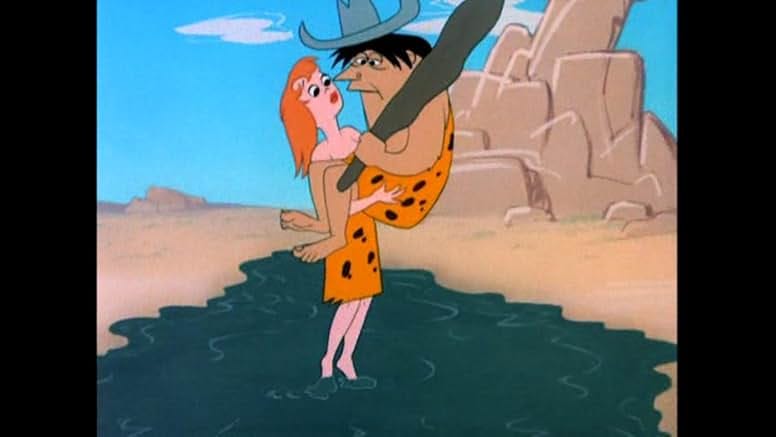
The cartoon, I later worked out, was The First Bad Man, a Metro-Goldwyn-Mayer short directed by Tex Avery and released on September 30, 1955. It is a Western set “one million years ago,” in a Dallas that has not yet been invented, where the cattle are brontosauruses with the heads of Texas longhorns and the bank, the saloon, and the jail are all made of rock. The narrator is the singing cowboy Tex Ritter, and according to a December 7, 2020 piece by the animation historian Keith Scott at Cartoon Research, this is “the only cartoon by Tex ever to carry an on-screen voice credit.” Two Texes, one Tex-ish premise. The villain, Dinosaur Dan, rustles the longhorn-brontosauruses and “runs off with all the pretty women,” and the good citizens eventually chisel a jail around him out of solid rock. The final gag reveals that the jail is still standing in modern Dallas, and that the narrator has been Dinosaur Dan all along. “When are y’all gonna let me out of here?” he asks.
But the part that made me sit up in my molded plastic chair came earlier. As the animation historian who blogs under the name Yowp described it in an October 16, 2018 post at the Tralfaz blog, the cartoon offers “a parade of pulled people”: one caveman after another hauling a woman home by the scalp while Ritter observes, with perfect deadpan, “Men had no trouble with their women in them days.” There is a follow-up about back seat drivers. The nagging cave-wife is voiced by June Foray, who would later be Rocky the Flying Squirrel, and she complains the whole way: “Slow down. Turn left. Watch that car.”
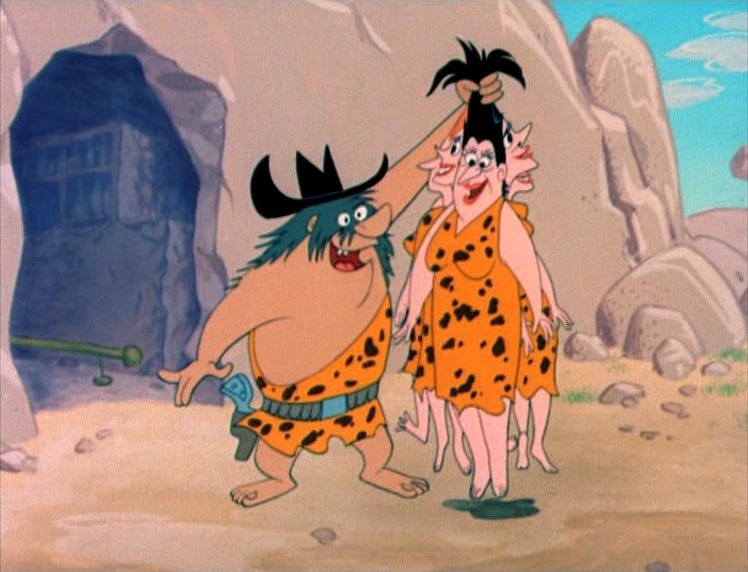
I laughed. Then I looked around the waiting room to see if anyone had noticed me laughing. Then I had the thought that I suspect everyone of a certain age has had while watching this sort of thing: my goodness, they really used to just put that on. And then, right behind it, a stranger question. Did cavemen actually do that?
It is a silly question. It is also, it turns out, an excellent one, because the answer reaches back further than the cartoon, further than the Flintstones, further even than the comic strips of the 1930s. It reaches back to a Scottish lawyer in 1865, to Charles Darwin, to a folklorist with a sense of humor, to Victorian postcards and vaudeville and the anxieties of men who had recently traded the plow for the office desk. The image is so familiar that it feels like it was always there, like a fossil. It was not. Somebody made it up, and then, over about forty years, everybody agreed to pretend they hadn’t.
What follows is an attempt to find out who, and why, and what the actual people of the Ice Age might think of the whole business.
Blame the Lawyer
The caveman with the club and the fistful of hair has a birth certificate, and the father listed on it never held a shovel.
John Ferguson McLennan was born in Inverness in 1827, became a Scottish advocate in 1857, and in 1865 published a book with a title only a lawyer could love: Primitive Marriage: An Inquiry into the Origin of the Form of Capture in Marriage Ceremonies. McLennan had noticed that wedding customs all over the world contained little pantomimes of abduction: the groom’s friends “stealing” the bride, mock struggles, ritual pursuit. He reasoned backward from the pantomime to the crime. Early humans, he argued, had been so hard pressed for food that they killed their infant daughters, which produced a shortage of women, which forced men to raid neighboring groups for wives. Marriage, in this telling, began as a kidnapping, and every veil and bridal carry since has been a faint echo of it.
It was a tidy theory. It was also, as the editor of a modern edition of McLennan’s work put it in a passage quoted by Livia Gershon in a December 9, 2019 article for JSTOR Daily, “almost entirely wrong.” Gershon, drawing on the literary scholar Nicholas Ruddick’s 2007 study “Courtship with a Club,” notes that the theory had “very little basis in reality” and that McLennan’s evidence was largely secondhand. According to a July 5, 2023 essay by the historian Tracey Cooper at The Past and Stuff, one of his key sources was an 1805 colonial account of “courtship by club” among Aboriginal Australians, a report of exactly the kind that nineteenth-century settlers were fond of producing about the people whose land they were taking.
None of this stopped the idea from spreading, in part because it acquired the best possible endorsement. In The Descent of Man (1871), Charles Darwin wrote: “It is hardly possible to read Mr. M’Lennan’s work and not admit that almost all civilised nations still retain traces of such rude habits as the forcible capture of wives.” Once Darwin had said it, the wife-snatching caveman was no longer a lawyer’s hunch. He was “science.”
The word itself was new. Merriam-Webster dates the first known use of “caveman” to 1862; the Online Etymology Dictionary puts “cave-man” at 1865, the same year as McLennan’s book, and notes that “cave-woman” did not arrive until 1904. The caveman, in other words, was born a bachelor and waited four decades for a wife, which, given his reputation, seems about right.
The first person to find this funny was, fittingly, a scholar. Andrew Lang was a folklorist and anthropologist who knew McLennan’s theory well, and in September 1880 he published a satire in Fraser’s Magazine called “The Romance of the First Radical: A Prehistoric Apologue.” It is a comedy of Ice Age manners, and it contains what may be the earliest joke version of the trope in print. Of the women of the tribe, Lang writes: “These ladies had been knocked on the head and dragged home, according to the marriage customs of the period.” And later, with a straight face: “Courtship had consisted in knocking a casual girl on the head in the dark, and the only marriage ceremony had been that of capture.” The scholar was mocking the theory. The mockery outlived the theory, and eventually became the thing it was mocking.
The pictures came next, and here the record gets interesting, because the earliest caveman cartoons were not about women at all. In 1893 the Punch artist E. T. Reed began a series called Prehistoric Peeps, collected in 1894 in a book that, according to the historian John van Wyhe’s catalog at Darwin Online, “sold out within a week.” Reed’s cavemen played cricket, hailed hansom cabs, and sat in Parliament. As the archaeologist Stephanie Moser observed in her 1998 study Ancestral Images, the Peeps were “almost exclusively male dominated” and “poked fun at knock-kneed politicians dressed up in skins, wielding clubs.” The club was there. The hair was not.
Someone had to bolt the courtship on, and the somebody appears to have been the postcard industry. Van Wyhe’s catalog records a 1905 series by the illustrator Lawson Wood titled “Pre-historic Courtship,” its four cards labeled “COURTSHIP,” “DISMISSING A RIVAL,” “MARRIAGE,” and “OFF FOR THE HONEYMOON,” followed by “The First Tiff” and “Divorce.” There were valentines: “I’ll be your cave man, If you’ll be my Valentine.” A 1919 valentine by Mabel Lucie Attwell, better known for drawing cherubic toddlers, carried the caption “AND ANOTHER LITTLE ‘BIFF’ WON’T DO HER ANY HARM.” A 1912 cartoon in the Daily News titled “The Prehistoric Argument” summarized the politics of the moment in five words: “Woman’s proper sphere is the cave.”
As for who drew the very first hair-drag, nobody seems to know. In 1958 a Los Angeles Times columnist named Timothy Turner called the image “a cartoonist’s formula for a laugh, and not a bad one all things considered,” and guessed it had started in an 1890s issue of Puck or Judge. The cultural historian Lynn Peril, who reported this in an August 23, 2019 essay at HiLobrow, went looking and found an 1897 Puck cartoon of a prehistoric “Mr. Henpeck,” but, she notes, “he wasn’t dragging anyone by the hair.” A 1906 New Jersey editorial she quotes has the caveman knocking a woman on the head and swinging her “over his shoulder,” which is close, but the grip is wrong. The earliest firmly dated drag I can find is not a drawing at all. It is Buster Keaton, in 1923, and we will get to him.
What we can say is that between roughly 1880 and 1920, a Victorian theory about wedding rituals, a folklorist’s parody of it, a Punch series about politicians in animal skins, and a flood of cheap romantic postcards fused into a single image. The image had the enormous advantage of being instantly legible. Club, cave, hair: three nouns, one joke, no caption required. And it arrived at a moment when, as Peril writes, “gender roles were rapidly changing” and “the office was replacing the farm as the place most men worked.” The men who laughed hardest at the caveman were the ones who had just been issued a fountain pen.
From Vaudeville to Bedrock
Before the caveman was a cartoon, he was a dating strategy.
Around 1907, “cave man” began to mean not a prehistoric person but a modern one with prehistoric manners. Green’s Dictionary of Slang finds the earliest example in a society novel of that year by the drama critic John Corbin, in which a woman remarks, “You’re rather abrupt and masterful, aren’t you? It’s the way with cave men.” By 1914 Sinclair Lewis had a timid clerk in Our Mr. Wrenn fretting, “I know about that caveman, Jack London’s guys. I’m afraid I ain’t one.” Jack London’s own prehistoric novel, Before Adam, had run in Everybody’s Magazine in 1906 and 1907, and it had a great deal to answer for.
The fad went mainstream fast. Lynn Peril, in her HiLobrow essay, found American newspapers in the fall of 1912 routinely describing real abductions as “cave man methods.” That same year the Independent Moving Pictures company released A Cave Man Wooing, in which a shy suitor takes a physical culture course from an instructor named “Prof. S. Trong” and wins the girl. D. W. Griffith’s Man’s Genesis, released July 11, 1912, gave the world two cavemen named Weakhands and Bruteforce competing for a woman named Lillywhite, and had Weakhands invent the club, which Griffith presented as a milestone in human progress. Gelett Burgess’s play The Cave Man ran on Broadway in 1911 and was filmed twice, in 1915 and again in 1926 with a young Myrna Loy in a small part; the plot involved a coal heaver who, having failed at high society, “reclaims” his heiress by carrying her off on a coal wagon. Charlie Chaplin put on animal skins for His Prehistoric Past in December 1914 and fought a king named Low-Brow over the king’s favorite wife with a club. Advice columnists weighed in. The silent star June Elvidge, billed as “The Most Proposed-to Woman in the World,” told readers in 1919 that the cave man was the “most thrilling” lover but warned self-reliant women, “He is not for you.”
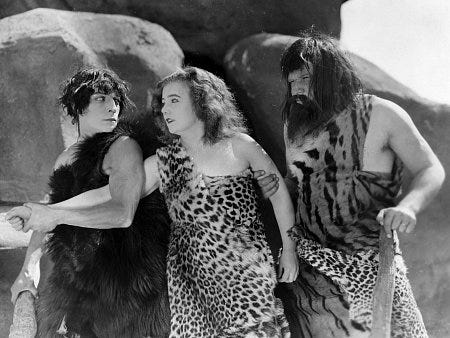
Then came Buster Keaton. Three Ages, released September 24, 1923, is a parody of Griffith’s Intolerance that follows one romance through the Stone Age, ancient Rome, and the present day. In the prehistoric segment, Keaton watches another caveman drag a woman away by the hair to claim her, tries the technique himself, and fails, because he is Buster Keaton and, well, the universe is against him. After finally besting his rival, played by Wallace Beery, he drags his sweetheart off by the hair, and she is delighted. It is, as far as I can find, the first fully documented hair-drag on screen, and it already treats the gesture as a well-worn convention. Keaton is not inventing a joke. He is doing a bit about a joke everyone already knows.
By the 1930s the image was standard equipment. Gershon at JSTOR Daily cites a 1934 New Yorker cartoon in which a caveman drags an unconscious woman home only to discover his wife is already there. The Leeds Mercury, reporting on the 1930 Railway Centenary pageant in Liverpool, ran the headline “CAVE-MAN STUFF” over a note that one episode “portrays a primitive man dragging his bride along by her hair.” This was a civic pageant celebrating trains. The caveman had become a stock character in the way a pirate or a cowboy is a stock character, and V. T. Hamlin’s comic strip Alley Oop, launched December 5, 1932, gave him a name, a stone axe, a kingdom called Moo, and a pet dinosaur named Dinny. Notably, the strip’s romantic violence tended to run the other way. Oop’s girlfriend Ooola, whose name was borrowed from “oh là là,” was known, in the words of the strip’s Wikipedia entry, for doing “serious violence to Alley’s cranium.” The two kissed exactly twice in the strip’s first 69 years.
Which brings us back to my dentist’s waiting room and Tex Avery. The First Bad Man arrived in 1955, when the trope was already sixty years old, and Avery treated it the way he treated everything: as a machine to be run at top speed. What Yowp’s Tralfaz post calls “a parade of pulled people” is the joke told over and over in a row, until the repetition itself becomes the gag. The layouts were by Ed Benedict, and according to a January 29, 2013 gallery at Cartoon Brew, Benedict “had designed cavemen and cavehomes” for this short before he did anything else prehistoric. Five years later, at Hanna-Barbera, he would recycle those designs for a new project.
That project was The Flintstones, which premiered on ABC on September 30, 1960, five years to the day after The First Bad Man was released. It was the first animated series in prime time, it was modeled closely enough on The Honeymooners that Jackie Gleason considered suing before deciding he did not want to be “the guy who yanked Fred Flintstone off the air,” and its first two seasons were co-sponsored by Winston cigarettes. What is striking is what it does not do. I could find no episode, and no historian who could name one, in which Fred drags Wilma anywhere. He bowls, he schemes, he gets yelled at. Nicholas Ruddick, in his 2009 book The Fire in the Stone, observed that the Flintstones are “modern people dressed in prehistoric outfits,” and that the show’s caveman material served as “mild satire of modern masculinity.” The club and the hair had been domesticated into a suburb. Johnny Hart’s strip B.C., launched February 17, 1958, kept two female characters named “Cute Chick” and “Fat Broad” until 2019, when the syndicate quietly renamed them Grace and Jane, after Hart’s mother and mother-in-law.
After Bedrock the caveman kept coming, but the drag became something the culture quoted rather than performed. Captain Caveman, who debuted on ABC on September 10, 1977 with Mel Blanc’s voice, flew by means of his club and pulled useful objects out of his body hair. Ringo Starr’s Caveman (1981) was performed in an invented language of about thirty words, with theaters handing out translation pamphlets; Starr met Barbara Bach on the set and married her a year later. Encino Man (1992) thawed a caveman in a San Fernando Valley backyard. The GEICO cavemen of 2004 flipped the whole premise: the joke was that cavemen were sensitive, well-dressed urbanites offended by the stereotype, and according to a March 19, 2007 column by Seth Stevenson in Slate, one of them ordered “the roast duck with the mango salsa.” The resulting ABC sitcom premiered October 2, 2007 and lasted one season. A 2002 New Yorker cartoon cited by Gershon updated the 1934 gag: a caveman drags his smiling male partner past a straight couple, and the wife says to her scowling husband, “Can’t you just be happy for them?”
A joke that began as a Scottish lawyer’s theory of wedding customs had, in 140 years, become a joke about the joke.
What the Bones Say
So: did they really do that?
The short answer is that there is no evidence they did, and a fair amount of evidence pointing somewhere gentler. The longer answer is more interesting, because it turns out the brute himself, the stooped and hairy figure behind the joke, was also a misreading.
Start with the club. Clive Gamble, the archaeologist who wrote the foreword to Stephanie Moser’s Ancestral Images, asks the obvious question: “Have we ever found a wooden club, especially a particularly gnarled one that any design-conscious Neanderthal simply must carry as an accessory? The answer is no.” Gamble traces the club not to any excavation but to the medieval “wild man” of European folklore, who carried one because “knights carried swords and outlaws either staffs, like Little John, or clubs.” The caveman inherited his signature prop from a figure in a tapestry.
Now the posture. In 1908 the brothers Bouyssonie and their colleague L. Bardon excavated a nearly complete Neanderthal skeleton at La Chapelle-aux-Saints in France. The paleontologist Marcellin Boule reconstructed it in 1911 as a slouching, bent-kneed, ape-like creature, and according to the Smithsonian’s Human Origins Program, that reconstruction is “the reason why popular culture stereotyped Neanderthals as dim-witted brutes for so many years.” The trouble was that the “Old Man” of La Chapelle had severe deforming osteoarthritis, and Boule had, in effect, drawn the species from its arthritic grandfather. Later work by Erik Trinkaus showed that the joint disease should not have changed the reconstruction, which is to say Boule’s stoop was as much ideology as anatomy. The same skeleton tells a different story if you read it differently: the man had lost most of his teeth, the bone had regrown along the gums, and he had lived to somewhere between 40 and 50. A 2014 study in PNAS, reported in The Conversation, confirmed he had been deliberately buried, and noted that “his group continued to feed him.” He could not have chewed his own food. Someone chewed it for him.
The pattern repeats at Shanidar Cave in Iraqi Kurdistan. The individual known as Shanidar 1 lived about 50,000 years ago and, as the anthropologist Erik Trinkaus and a colleague reported in PLOS One in October 2017, survived a crushing blow to the face, the loss of his right forearm, a bad limp, and, thanks to bony growths in his ear canals, profound deafness. He lived into his forties anyway. “More than his loss of a forearm, bad limp and other injuries,” Trinkaus said in an October 23, 2017 announcement from Washington University in St. Louis, “his deafness would have made him easy prey,” and his survival meant he was “dependent on other members of his social group.” A deaf, one-armed man cannot drag anyone home. He was, for years, the one being looked after.
Shanidar is also where the story of the sensitive Neanderthal took a famous wrong turn, and it is worth pausing on, because it shows that the corrective can be as much a fairy tale as the caricature. In the 1950s Ralph Solecki found pollen clumps around a burial there and concluded, in a 1971 book called Shanidar: The First Flower People, that mourners had laid flowers on the dead. It was a lovely idea. A November 2023 study in the Journal of Archaeological Science by Chris Hunt, Emma Pomeroy and colleagues reexamined the pollen and proposed that at least some of the clumps had been placed there by nesting solitary bees; about a quarter of the clumps mixed species that do not bloom at the same time. The flowers may have been the bees’ doing. The burial itself, the authors stressed, was real: Shanidar 4 lies in a “tight cluster of remarkably complete and deliberately emplaced” skeletons. In May 2024 the University of Cambridge announced the reconstruction of another member of that cluster, Shanidar Z, a woman of about 75,000 years ago who died in her mid-forties and was laid within arm’s reach of where the living cooked and ate. “The Shanidar Neanderthals,” the archaeologist Graeme Barker said, “may have been thinking about death and its aftermath in ways not so very different from their closest evolutionary cousins, ourselves.”
They also accessorized. A March 2015 paper in PLOS One described eight white-tailed eagle talons from Krapina, in Croatia, about 130,000 years old, bearing cut marks and polish consistent with having been strung and worn. By 2019, according to a November 1, 2019 report in Smithsonian Magazine, the evidence for Neanderthal personal ornament spanned “more than 80,000 years.” Nobody who has spent an afternoon polishing an eagle claw for a necklace is a stranger to the idea of trying to impress someone.
And the women? The Victorian theory required them to be scarce, passive, and portable. The more recent evidence is not kind to that requirement. In 2018 archaeologists excavating a 9,000-year-old burial at Wilamaya Patjxa in the Peruvian Andes found a young adult buried with a full big-game hunting kit, projectile points and butchering tools, and determined the hunter was female. When the team, led by Randall Haas, surveyed 429 burials across the Americas, the Science Advances paper they published in November 2020 found that of 27 individuals buried with big-game tools, 11 were women and 15 men, suggesting that “somewhere between 30 to 50 percent of hunters in these populations were female.” A June 2023 PLOS One survey of 63 foraging societies found that 79 percent documented women hunting, a finding that drew a methodological critique, as such findings do, but that fits a larger picture. The anthropologists Cara Ocobock and Sarah Lacy, writing in Scientific American on November 1, 2023, reported that “Neandertal females and males do not differ in their trauma patterns, nor do they exhibit sex differences in pathology from repetitive actions.” Whatever they were doing, they were doing it together. Lacy put the point more plainly in an interview with the University of Delaware that October: “We were a very egalitarian species for millions of years in many ways.”
Ocobock and Lacy closed their article with an image I hadn’t expected. “Now when you think of ‘cave people,’” they wrote, “we hope you will imagine a mixed-sex group of hunters encircling an errant reindeer or knapping stone tools together rather than a heavy-browed man with a club.”
Even the hair was wrong. The women of the Ice Age appear to have cared about theirs a great deal. The Venus of Willendorf, found on August 7, 1908 and about 30,000 years old, wears a head of circular bands that have been read as plaited hair or a woven cap; the archaeologist Olga Soffer has suggested the sculptor may have been recording basketry. The tiny ivory head from Brassempouy, found in 1894 and about 25,000 years old, is carved with a checkerboard pattern that scholars have interpreted as a wig, a decorated hood, or hair styled in cornrows. Someone spent hours on that coiffure, in ivory, with stone tools. The idea that it existed mainly to be grabbed would have struck them, one suspects, as a strange use of the material.
Why It Worked, and Why It Stuck
If the caveman never dragged anyone, why did the joke run for a century? Part of the answer is craft. As a piece of visual shorthand it is nearly perfect: one figure, one prop, one gesture, no words. A cartoonist can draw it in thirty seconds and a reader can decode it in one. Tex Avery understood this, which is why The First Bad Man does not tell the joke once but runs it as a conveyor belt.
But Nicholas Ruddick, who has thought about this longer than anyone, offers a less comfortable reason. Wife-capture, he wrote in a passage quoted by Tracey Cooper, “is tinged with an uncanny primal erotic that survives most attempts to deny, ironize, or mock it.” The Victorians, he notes, mostly cast the club-wielding suitor as a villain “destined to be defeated and superseded by men with more chivalrous manners.” That is Griffith’s Weakhands beating Bruteforce, and Keaton beating Beery. The trouble is that the villain got the better costume. The sociologist Lisa Wade, quoted in the same essay, put the cost bluntly: the myth “seems silly and innocuous” but “actually helps to naturalize man’s aggressive pursuit of sex with women.” The scholar Elise Kramer, in a 2025 article in the journal Signs and Society, called such stories “paleofantasies” and argued they work by “projecting” modern gender contrasts “across a temporal divide,” which is to say they launder the present by calling it the past.
One can hold both things at once: that the gag is funny, and that its funniness is doing some quiet work. The waiting room laugh and the wince are the same reflex, a half-second apart.
A few things I did not expect to learn along the way:
The word “caveman” is younger than the theory that made him a kidnapper. Merriam-Webster’s first citation is 1862; McLennan’s book is 1865. “Cave-woman” waited until 1904.
The earliest joke about it is by a professional anthropologist, Andrew Lang, in 1880, thirteen years before Punch’s cavemen and forty-three before Keaton’s.
Green’s Dictionary of Slang defines “cave-man stuff,” first recorded in 1916, as “a rough form of wooing or love-making, reminiscent of the clichéd cave-man who (at least in cartoons) drags his woman around by her hair.” The dictionary itself puts the drag in parentheses and in cartoons.
The Hollywood Argyles’ “Alley Oop,” written by Dallas Frazier in 1957 and a number-one hit in 1960, gives its hero “a big ugly club and a head full of hair” but never has him drag anyone. David Bowie lifted the line “look at that caveman go” for “Life on Mars?” The Argyles, by the producer Gary Paxton’s own admission, did not exist when the record was cut.
Iraan, Texas, the oil town that claims Alley Oop as its own, built an “Alley Oop Fantasy Land” in 1965 with a 65-foot statue of Dinny the dinosaur, according to a University of Missouri Libraries exhibit.
The Flintstones were not the first television couple shown in one bed; that was Mary Kay and Johnny on DuMont in 1947, according to Snopes. Fred and Wilma were the first animated one.
Gary Larson’s 1982 Far Side cartoon naming the spikes on a stegosaurus tail “after the late Thag Simmons” gave paleontology the term “thagomizer,” which the Smithsonian now uses without irony.
Raquel Welch had three lines in One Million Years B.C. (1966), according to a July 5, 2011 piece in TIME. The poster did the rest, and later hung on Andy Dufresne’s cell wall.
A 1940s men’s shirt advertisement, displayed in a 2019 Neanderthal exhibition at the Canadian Museum of History, showed a cavewoman hauling a well-dressed man off by his hair. The trope could be reversed for a laugh as early as the 1940s, which suggests the audience already knew it was a costume.
The curator of that exhibition, Janet Young, said of the original Neanderthal reconstructions: “That was a time of colonialism and European superiority, and that was the framework that guided interpretation.” The brute was drawn by people with a use for brutes.
Real bride kidnapping exists, and is a different thing. The Kyrgyz practice known as ala kachuu, literally “to take a young woman and run away,” is illegal and, according to its Wikipedia entry, was rare until Soviet times and increased sharply in the twentieth century. It is not an Ice Age survival. It is a modern crime with a folkloric alibi, which is, in the end, exactly what McLennan’s theory offered.
The Cave We Keep Returning To
The hygienist eventually called my name, and I left Dinosaur Dan in his rock jail, still asking to be let out.
What stays with me is not that the cartoon was wrong. Cartoons are allowed to be wrong; that is most of what they are for. What stays with me is how thoroughly a made-up past can feel like a remembered one. I did not learn the caveman from a museum. I learned him from Saturday mornings, from newspaper strips read upside down across a kitchen table, from the same six-minute shorts that are still, apparently, being piped into dental offices in 2026. He arrived pre-installed. And because he arrived that way, it never occurred to me, until a numb-jawed morning this fall, to ask who had installed him.
The answer is almost comically specific: a lawyer with a theory about wedding veils, a naturalist who trusted him, a folklorist who mocked him, a magazine that dressed Parliament in animal skins, and a postcard industry that noticed the skins sold better with a girl in the picture. Then a silent comedian, a Texan with a cowboy narrator, and a Sunday-night sitcom about a quarry worker in a suburb. None of them dug anything up. All of them were describing themselves. The caveman is a mirror that has been mistaken for a window for about a hundred and forty years, and the people who have actually looked through the window, at the toothless old man whose family chewed his food, at the deaf hunter who lived into his forties, at the woman buried with her spear points, keep reporting that the view is nothing like the drawing.
And yet I am not sure I want the drawing gone. There is something worth keeping in the laugh, if only because the laugh is the moment you notice what you had been taking for granted. Ruddick is right that the image carries a charge that survives being mocked. But it also survives being corrected, and that is stranger. We know now that it was invented. We can date the invention. We can name the inventors. The knowledge does not seem to loosen the grip at all. “Progress,” in the matter of cavemen, has meant learning more and more about them while the picture in our heads stays exactly where the postcard artists left it.
Perhaps that is the real lesson of the trope, and it is not about the Paleolithic. It is that we are a species that would rather have a vivid past than an accurate one, and that we will accept a Scottish lawyer’s guess over a Croatian eagle claw if the guess comes with a better drawing. The actual people of the Ice Age buried their dead close to the hearth, polished talons for necklaces, and carved careful braids into ivory the size of a thumbnail. They left no clubs. They left no drawings of anyone being dragged. What they left, mostly, is evidence of care, which is much harder to draw in thirty seconds.
I still think the cartoon is funny. I am less sure, now, what I am laughing at.
Sources
Keith Scott, “AVERY…. Vol. 2??? WELL, IMAGINE THAT!”, Cartoon Research, Dec. 7, 2020
Yowp, “Cue the Old Jokes Again”, Tralfaz, Oct. 16, 2018; and “Before the Flintstones”, Oct. 12, 2012
The First Bad Man, Wikipedia; episode summary at TheTVDB
Amid Amidi, “The Organic Architecture of ‘The Flintstones’”, Cartoon Brew, Jan. 29, 2013
Livia Gershon, “The Truth about ‘Caveman Courtship’”, JSTOR Daily, Dec. 9, 2019
Lynn Peril, “Planet of Peril (41): The Cave Man Lover”, HiLobrow, Aug. 23, 2019
Tracey Cooper, “Caveman Courtship”, The Past and Stuff, July 5, 2023
Nicholas Ruddick, “Courtship with a Club,” Yearbook of English Studies 37:2 (2007); The Fire in the Stone (2009), reviewed at Strange Horizons
Charles Darwin, The Descent of Man, ch. V (1871)
Andrew Lang, “The Romance of the First Radical” (1880); SF Encyclopedia entry
John van Wyhe, “Caricatures of Evolution: Cavemen”, Darwin Online
Stephanie Moser, Ancestral Images: The Iconography of Human Origins (1998), foreword by Clive Gamble
Andrew Horrall, Inventing the Cave Man: From Darwin to the Flintstones (Manchester University Press, 2017)
“caveman”, Merriam-Webster; Etymonline; Green’s Dictionary of Slang
Wikipedia entries for Three Ages, Man’s Genesis, His Prehistoric Past, The Caveman (1926), A Cave Man Wooing, Alley Oop, Alley Oop (song), The Flintstones, B.C., Captain Caveman, Caveman (1981), GEICO Cavemen, Thagomizer, Ala kachuu, Venus of Willendorf, Venus of Brassempouy
Seth Stevenson, “Neanderthal TV”, Slate, March 19, 2007
David Mikkelson, “Early to Bed”, Snopes, 1999, updated 2022
Chris Gayomali, Raquel Welch in TIME, July 5, 2011
Patrick Langston, “Misunderstood”, ARTSFILE, May 17, 2019
Smithsonian Human Origins, La Chapelle-aux-Saints; The Conversation, “Neanderthal dispute laid to rest” (2014)
Gerry Everding, “Older Neandertal survived with a little help from his friends”, Washington University in St. Louis, Oct. 23, 2017
Hunt, Pomeroy et al., “Shanidar et ses fleurs?”, Journal of Archaeological Science, Nov. 2023; University of Cambridge, Shanidar Z, May 2, 2024
Radovčić et al., “Evidence for Neandertal Jewelry”, PLOS One, March 11, 2015; Megan Gannon, Smithsonian Magazine, Nov. 1, 2019
UC Davis via ScienceDaily, Wilamaya Patjxa, Nov. 5, 2020; Anderson et al., “The Myth of Man the Hunter”, PLOS One, June 28, 2023
Cara Ocobock and Sarah Lacy, Scientific American, Nov. 1, 2023; Sarah Lacy interview, UDaily, Oct. 17, 2023
Elise Kramer, “The Caveman in the Mirror”, Signs and Society, 2025