

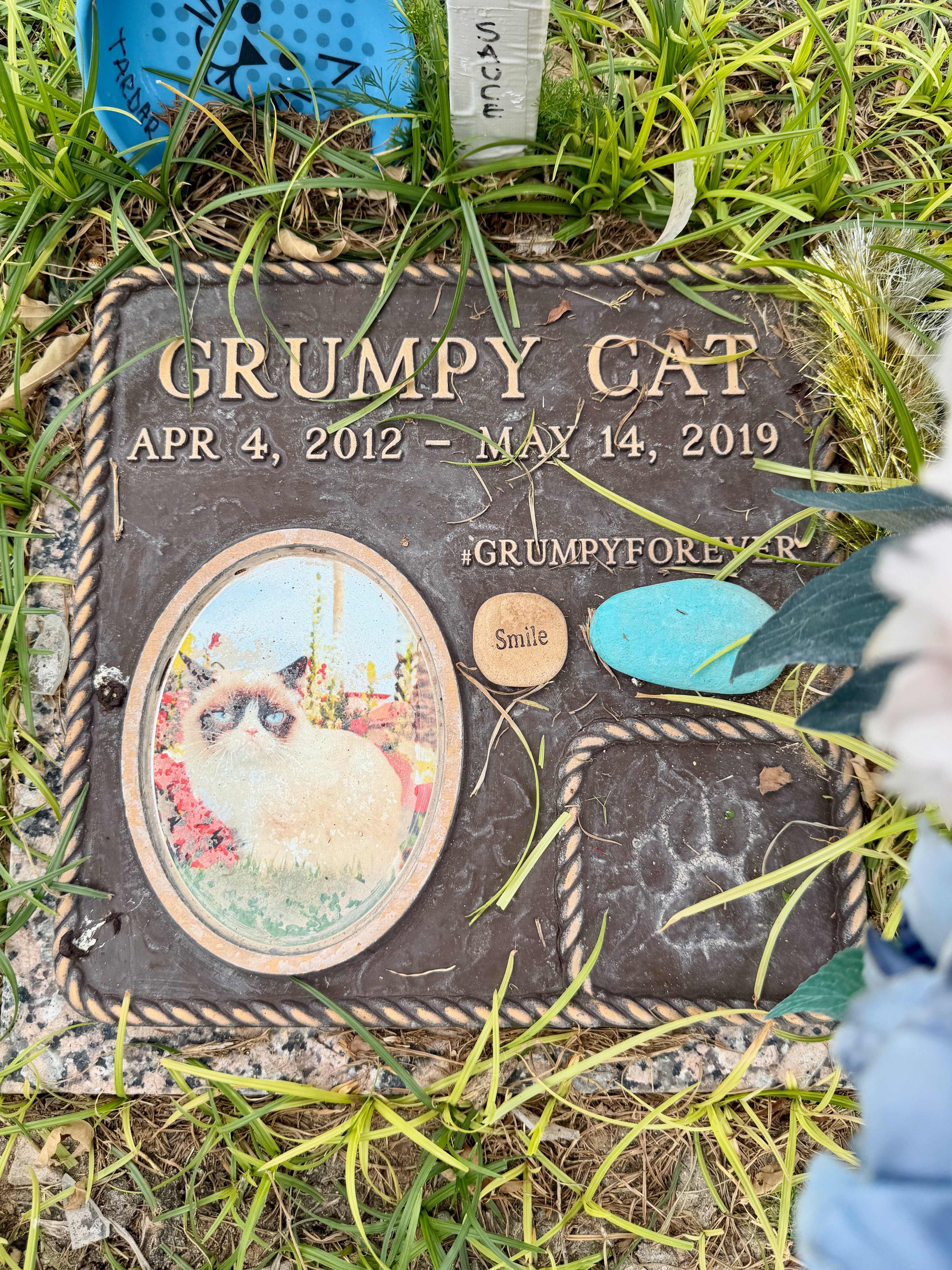
There is a five-acre cemetery on the northwest edge of Phoenix, in a town built and zoned for the last chapter of human life, where someone has carved the word soulmate into granite. Someone has carved best little buddy. Someone carved God’s gift to us, and my precious angel, and pretty girl, and our golden happiness. Someone carved a hashtag in bronze. Someone left a small stone that says Smile at the grave of Grumpy Cat, who was famous on six continents for refusing to. Someone buried a chicken here, and an iguana, and a pair of cockatiels, one of whom lived to twenty-five. Someone asked to bury a horse and was told no. A husband and wife asked to be buried beside their chimpanzee and were told no, and the refusal is not the remarkable part. The remarkable part is that the request was made: two human beings surveyed every consecrated acre available to them and chose this one. Someone tends a grave marked Churro, My Little Girl, born November 30, died November 30, fourteen years apart, the whole circle closed on a single square of the calendar. And someone, mourning a puppy who lived nine months, nine, paid for granite and a frame and a portrait printed on a sunset, and beneath the portrait had the mason carve the only words that mattered, the words they must have said a thousand times into the fur of her neck without once wondering what they meant: Lucy Lou. Made of the goo. We love you old girl.
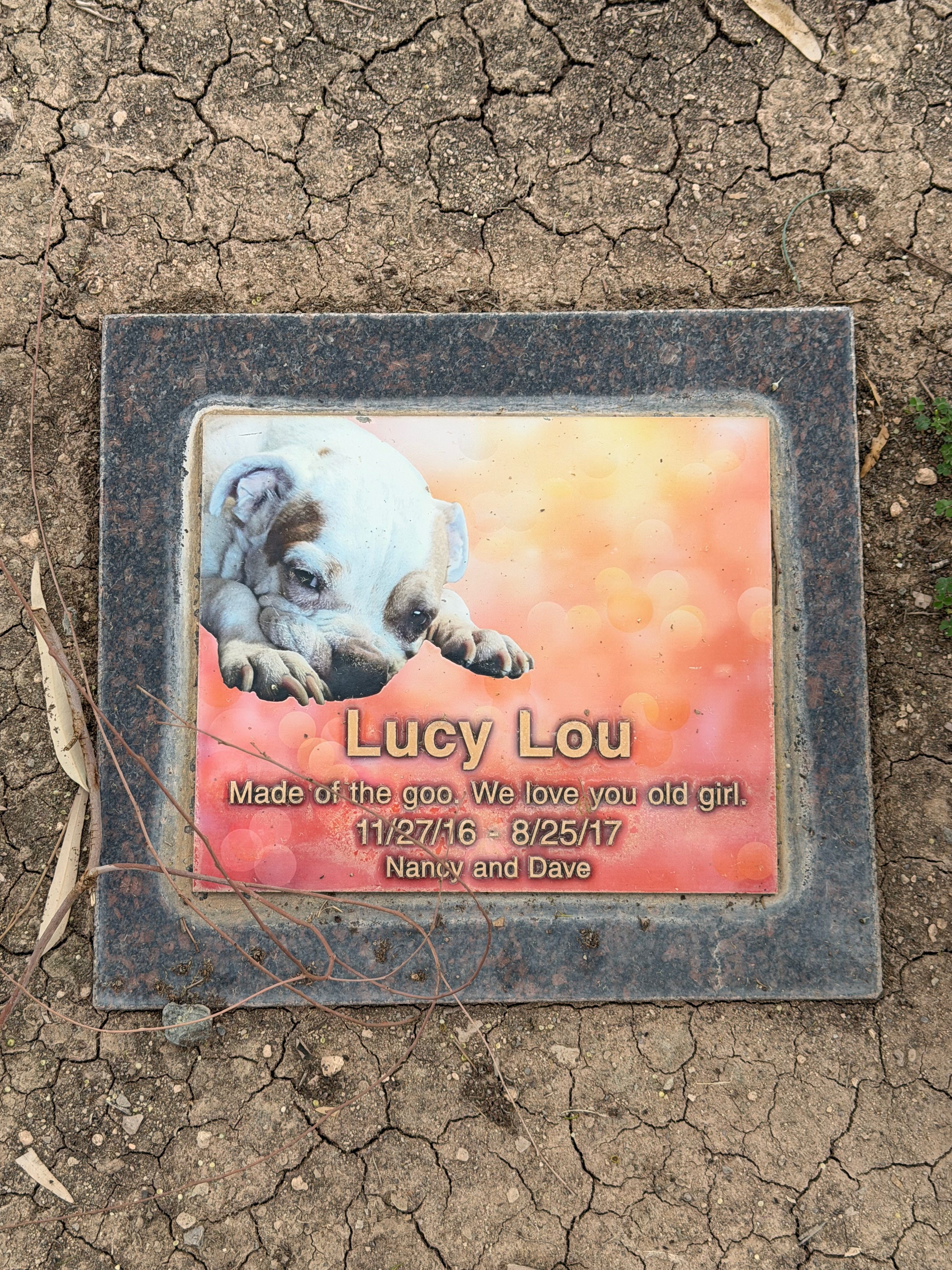
The goo is not a mystery. It is nonsense, and it is nonsense on purpose. It rhymes with Lucy Lou, the way love-talk always drifts toward rhyme, and it suits a wrinkled white puppy, who is mostly goo to begin with. Affection past a certain temperature stops making sense and starts making sounds. Nobody footnotes a lullaby. We will come back to the goo.
And yet, until this spring, I had never stood in a pet cemetery. Not once, in a life that has included a fair amount of standing around in regular ones. The only story my culture ever handed me about ground like this was a horror story.
I saw Pet Sematary young enough that it took. Stephen King’s version is sour ground behind the new house, a sign misspelled by children, and one commandment delivered in a Maine drawl: sometimes dead is better. The love you bury there comes back wrong. That was the entire cultural file I carried on pet cemeteries for thirty years, and it worked on me the way horror is supposed to work. I never visited one. I assumed, without ever quite forming the thought, that a pet cemetery would be one of two bad things: haunted, or ridiculous.
So let me make my confessions early, because I have several. I shared her face. For the better part of a decade I used the photograph of a cat with feline dwarfism and an underbite to say no, to say Mondays, to say things to coworkers and family that I was apparently too embarrassed to say in my own words. Half the planet did this, and I was not an exception. Second confession: the title of this essay contains her name because her name pulls search traffic, and I know it pulls search traffic because I checked, because checking things like that is what I do for a living. I am monetizing this animal one more time, right now, in the sentence you are reading. The line for the barge forms to the left. Third confession, the one this whole essay sits on: I walked in expecting haunted or ridiculous. I walked out with something lodged in my chest, and it has been there since, small and smooth and impossible to read, like a stone that says Smile.
II.
We were in Sun City because Diantha’s aunt lives there. Diantha is my wife. Dylan, twelve, is our son. That is how most people arrive at the sacred: sideways, in the orbit of a relative. Sun City is the original master-planned retirement community, a town with a minimum age, laid out in circles like the rings of a tree, where the golf carts are street-legal and the streets are named for ease and rest. And on a day off from the visiting, because I had read that the most famous cat in the history of the world was buried right there in town, the three of us drove to Sunland Memorial Park and drove past the human graves to the back acres, where the pets are.
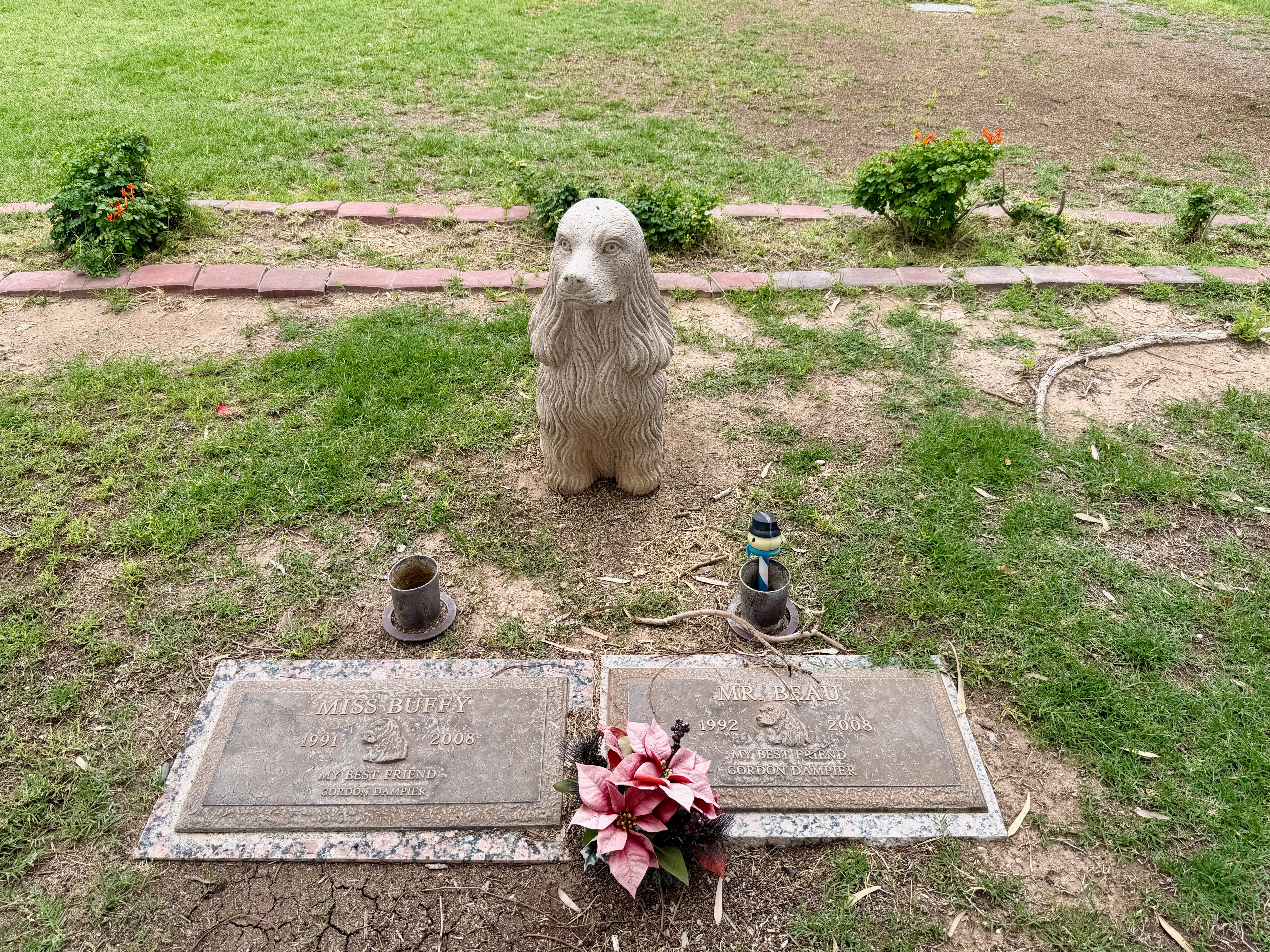
It does not look haunted. It looks like a kindergarten art show curated by grief. There are painted rocks. There are silk flowers in tin vases standing before a marble wall of bronze plaques: John’s Boys. Our Little Darlin’. Loyal Pals. A Gift From Heaven. There is a dog named Chang Chu Lee buried beneath a bronze bone the size of a serving platter, and I defy any human memorial designer to improve on it. There is a dog named Sammy Woo, and a dog the stone is careful to identify the way his family actually spoke of him, quotation marks and all: Miles “Bubbas” Filip. Diantha and I did some quiet arithmetic, somewhere between the marble wall and the bronze bone, and concluded that several of these animals are resting under more stone than the two of us are likely to afford for ourselves. We laughed about it.
And then, in the farthest southwest corner of the grounds, about as far as the cemetery can carry you, there is the bronze. GRUMPY CAT, it says, APR 4, 2012 to MAY 14, 2019 with an oval portrait of the scowl that needs no caption anywhere on Earth, and her paw print cast beside it, and beneath all of this, set in a metal intended to outlast everyone reading this sentence: #GRUMPYFOREVER. A hashtag. In bronze. The most disposable form of language our species has ever invented, rendered in the most permanent medium we have, and I stood there genuinely unable to decide whether it was the silliest thing I had ever seen or the first artifact of a civilization learning to say eternal in its new language. The most famous animal in the history of the world lies in open ground, level with the dirt, level with the chicken and the iguana, and anyone may walk up and stand over her, and everyone does. Pilgrims had been there before us. They are there every week. Somebody left a pet dish bearing her real name, Tardar Sauce, and somebody else a hand-lettered sign, and somebody a turquoise rock, and somebody, God bless them forever, a small flat stone bearing the one word she was famous on six continents for refusing: Smile.
I knelt there for a while, trying to decide whether the stone was a joke or a prayer.
III.
Here is the most honest thing I can report from that acre. Human headstones record rank, service, office, degree: Colonel, Reverend, Beloved Physician, the resume compressed to its final bullet. These stones record no accomplishments at all. Not one, anywhere, in five acres. A pet’s headstone is the only monument we build that records nothing the dead ever did and everything they were to someone. Soulmate. Best little buddy. My precious angel. God’s gift to us. The entire vocabulary is relation. Imagine a human cemetery written this way. It is a better cemetery.
And the language is private. That is the other thing. Every pet accrues names the way a hull accrues barnacles: the formal name, the short name, the nickname, the nickname’s nickname, the noises that eventually replace all of them. An inside joke is normally the most perishable thing a household owns; it dies with its speakers, undocumented by design. The pet cemetery is the one place on Earth where the inside joke gets published. Bubbas, in quotation marks, in granite. Made of the goo, which I am prepared to believe was said nightly, in a particular voice, into a particular neck, and which Nancy and Dave decided the world could see, because being understood by strangers was never the point of it. We talk to dogs, after all, the way we talk to babies, in the same pitched-up singsong nonsense, and the resemblance is the whole secret. Baby talk is language with the information removed: no argument, no instruction, pure melody, the sound of the relation itself. The difference is that the baby graduates. One day the child answers in sentences and the nonsense retires, a scaffold taken down from a finished building. The dog never graduates. A dog receives the purest register of human speech, the one carrying nothing but love, every day of its life, first to last. That is what got carved at Lucy Lou’s grave. Not a sentence. A register. Tardar Sauce is the same species of word: kitchen-counter nonsense, baby talk, the dialect of one family. The only difference is what happened next. One of these private words stayed private, and the other became a federally registered trademark that a jury once defended to the tune of seven hundred and ten thousand dollars. Both of them ended up in the same dirt.
IV.
The stones make promises, too. Reunited in heaven, never to be separated again, one says, in full, unembarrassed serif. Official theology has hedged on the souls of animals for two thousand years; popes have suggested it and unsuggested it; the catechism clears its throat. The people of Sun City did not wait for the ruling. When the memorial park first proposed a pet section, the lawyers killed it over the question of whether an animal could decently rest within sixty feet of a human being. The residents of a retirement community then produced four thousand signatures demanding it anyway, and love, as it occasionally does, won on appeal. The cemetery opened with five acres and fifteen thousand spaces, and among its first residents were four hundred pets exhumed and carried over from Tempe, where a freeway needed their ground. Even the dead pets of Arizona, it turns out, can be displaced by progress and granted asylum by retirees.
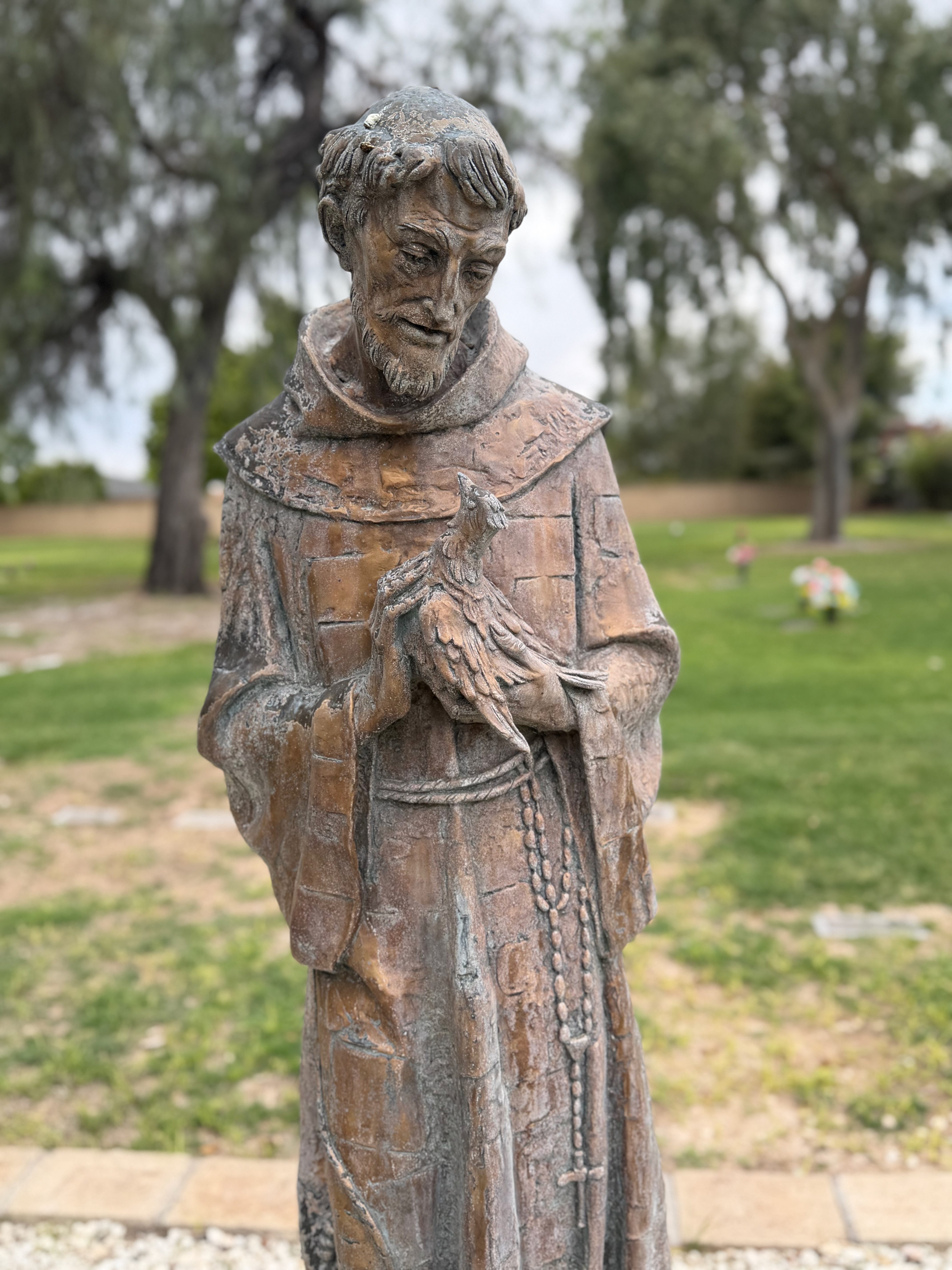
We used to be better at admitting we believe these things. Now we mostly admit it here. The most recited elegy in the English language is a short anonymous prose poem about a meadow at the edge of heaven where the animals wait for us, handed across veterinary counters for forty years with no author attached, a psalm the hymnal declined to print, so the people photocopied it. In it, the animals who loved us wait in a sunlit meadow, made young and whole again, until the day each one stops mid-play, stares hard at a far figure coming over the grass, breaks into a run, and the two of them cross the bridge together. (Decades on, a researcher finally traced it to its source: a Scottish teenager had written it in 1959, in about an hour, for a dog named Major, and told almost no one.) And over the whole acre in Sun City stands a bronze St. Francis, the church’s one concession, head bowed, holding a bird that will not fly away.
V.
We have been here before. Let me tell you where.
It is festival season in Egypt, and the river is loud. Barges are coming down the Nile toward the city of Bubastis, hundreds of them, riding low with pilgrims, and the pilgrims are not solemn: there are castanets, there are flutes, and there is more wine drunk on this route in these weeks, Herodotus swears, than in all the rest of the year combined. Seven hundred thousand people are converging on the temple of a goddess with a woman’s body and a cat’s head. Her name is Bastet. She is the protector of the household, of women, of children, of the hearth, which is to say she is the protector of everything a cat sits in the middle of. In her city, the cats live in the temple precincts and are fed like senators.
And when a house cat dies a natural death, anywhere in Egypt, the household goes into mourning, and the mourning has a uniform: every person in the house shaves off their eyebrows. Nothing else. Just the eyebrows. Grief, worn on the face, for exactly as long as it takes eyebrows to grow back, so that biology itself keeps the calendar of mourning. The cat is taken to the embalmers, anointed with cedar oil, wound in linen, and laid in a vault with tens of thousands of others. To kill a cat in Egypt, even by accident, is to risk dying at the hands of the crowd before any magistrate can reach you. A Roman visitor once learned this the hard way, and not even the threat of war with Rome could talk the mob down.
Hold that picture. The barges, the wine, the shaved faces, the linen, the vaults. The most sophisticated civilization on Earth, organizing real infrastructure around the death of cats. It is the most tender logistics operation in the ancient record. Of the two great stories our species tells about ground like this, the worship and the horror, I had only ever been taught the horror, and taught it twice, because Hollywood filmed it twice.
Now let the centuries run. The temples close. The goddess stops getting her mail. And late in the nineteenth century, farmers digging near Beni Hasan break through the roof of one of the old vaults and find the cats still there, hundreds of thousands of them, still wound in their linen, still waiting. What happens next is not a myth, and I will tell it straight. The find is sold. Nineteen tons of mummified cats, an estimated one hundred and eighty thousand animals, are loaded onto a ship and sent to Liverpool, where they are auctioned, ground up, and spread as fertilizer on the fields of England. At the auction, the story goes, the man with the hammer used a mummified cat’s head for a gavel.
That is the other half of the story we are standing in, and it is the half I work for. We have done this before: loved an animal into a god, then rendered the god into product. The Egyptians took four thousand years to travel from the temple to the fertilizer auction. We are faster now. Grumpy Cat went from one photograph, posted by her owner’s brother, to a global brand in about a week: the talk shows, the book deals, the cat food sponsorship, the television movie, the licensing empire, the federal lawsuit, the seven hundred and ten thousand dollars. The grinding starts earlier now, while the beloved is still alive, and we have renamed it engagement. I shared her face. I checked her search volume to title this essay. The barge, as promised, was boarding the whole time.
Her real life ran underneath all of it, at cat scale. She was born in a house in Morristown, Arizona, up the road from where she lies now, one kitten in a litter of four. The famous expression was a side effect of feline dwarfism and an underbite, which means the face the planet read as contempt was a face the planet was misreading. By every account she was a calm, ordinary, affectionate animal. She did not know she was famous. She did not know she was a trademark. And on a May night in 2019, at the age of seven, she died of complications from a urinary tract infection, at home, in the arms of the woman who had named her after a sauce. Whatever the internet is, it grieved. The grief looked like the internet: candles made of pixels, flowers made of nothing. On her memorial page, strangers are still leaving virtual flowers, thousands of them now, to this day, for a cat.
VI.
We are at Bubastis again, my friends. The barges are browsers now and the wine is worse, but the pilgrims still come, to a back acre of a retirement community, carrying painted rocks. There is a decent chance her face is in your phone at this moment, filed in some sticker drawer you have forgotten, waiting to say no on your behalf. That makes you part of this. It made me part of it long before I knew where she was buried.
Dylan knew the face the way his generation knows it, which is fluently and bodilessly: a reaction, a sticker, a unit of language you deploy. She died when he was five, before memory had anywhere to put her, so she reached him as image only. And at the grave I watched something cross his face that I can only call confusion, the good kind, the kind that comes just before an education. We asked him if he remembered Grumpy Cat. He looked at the bronze, and the confusion did not resolve so much as deepen, and he said: the meme, right? He had answered a question about an animal by naming a format. The trouble, as far as I could tell, was the body. Nobody had ever told him the meme had been an animal: that it ate, that it was carried from room to room, that it got sick, that it was held. The internet had handed him the scowl with the creature already removed, the way Liverpool received the linen with the cat already rendered. The grave put it back. A square of bronze in the ground did, in one minute, what ten thousand impressions of her face had never done for him. It reattached the word to the thing the word was for. He stood there doing the arithmetic children do silently, and I let him do it, because it is the central arithmetic of the century he owns, and the grave teaches it better than I can: everything on the screen was somewhere a body first.
VII.
Near the back of the grounds there is a memorial of a different kind. It honors several hundred greyhounds who were found dumped in an orchard outside Mesa after their racing careers ended. Their left ears had been cut off, because the left ear carried the identifying tattoo. The industry that numbered them did not want them counted. They are remembered here by strangers, in a cemetery that never asks about accomplishments. That is the answer to anyone who walks this acre and sees only kitsch. The painted rocks share the ground with this. The place is not decoration. It is where we file the love that had nowhere else to go, and the grief that some ledger somewhere refused to carry.
VIII.
Before we left, I went back to the bronze. The scowl in its oval portrait. The paw print. The hashtag underneath, reaching for the word forever in the only grammar it knows. The pet dish with her real, ridiculous, private name. And the small flat stone, still there, that says Smile.
I had knelt there a half hour earlier trying to decide whether the stone was a joke or a prayer, and I would like to report that I have since decided, but I have not. I am no longer sure the ground recognizes the difference. For ten years we used her face to say the things we could not say straight, and now the pilgrims use her grave the same way, and a stone that would be a smirk anywhere else on Earth becomes, on this acre, something a person sets down gently with two fingers and steps back from.
The goo, it turns out, was never a mystery. It is what love sounds like once it stops needing to mean: the rhyme reached for in the dark, the sounds we make at creatures who cannot parse them and were never asked to. Lucy Lou was made of it, nine months’ worth. The cat under the bronze was made of it, and the greyhounds, and the aunt we had come to see, and the boy doing silent arithmetic beside me, and Nancy, and Dave. Somebody, someday, will have to carve our inside jokes for us, in whatever private language is left when we go.
What will the stone say? And will it rhyme?