

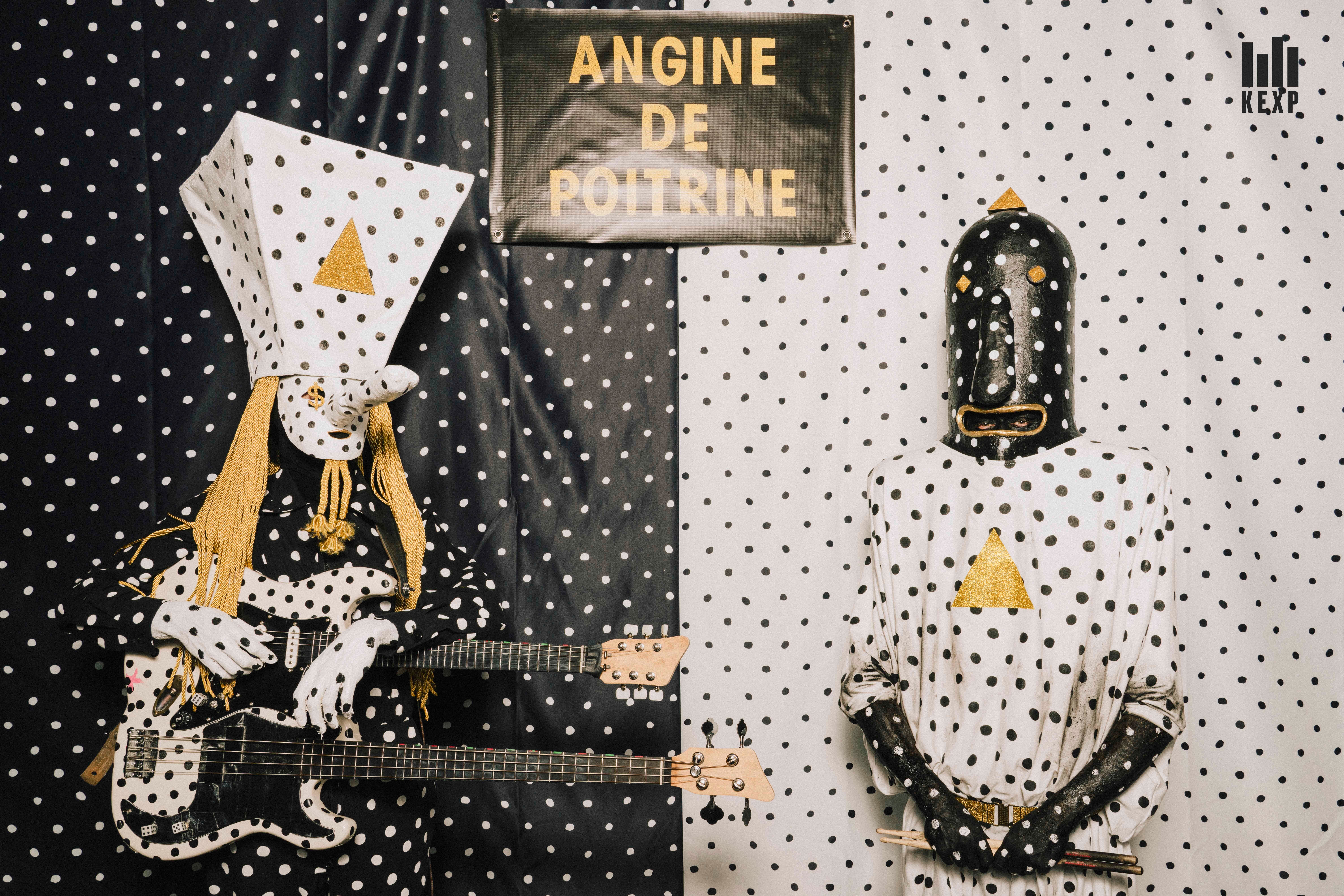
The video is twenty-seven minutes long. Nobody is supposed to watch a twenty-seven-minute video anymore. And yet, since it appeared online in February, millions of people have done exactly that, following two figures in long-nosed papier-mâché masks and black-and-white polka-dot costumes through a performance that feels less like a concert and more like a ritual staged somewhere between a children’s theater and a malfunctioning machine.
The figures are Khn and Klek de Poitrine, the pseudonymous duo behind Angine de Poitrine, a band from Saguenay, Quebec, that formed around 2019 as, by their own account, a joke that refused to stop. Their music, which they call “mantra-rock,” leans on microtonal guitar, looping architecture, and rhythmic patterns that never quite resolve. They perform without speaking. They communicate through gestures, including a triangle sign that audiences have begun to mirror back at them. Their vinyl debut recently sold on Discogs for roughly €1,500.
To sit with the performance is to feel your sense of musical expectation slowly misalign. The first minutes register as error, as if the instruments have slipped out of tune with themselves. Notes land just off center. The rhythm circles without closing. What sounds wrong at first begins, with time, to feel deliberate. The repetition builds pressure rather than release. By the midpoint, the absence of a hook stops reading as lack and starts to feel like a refusal. You are no longer waiting for a moment. You are inside a pattern that does not intend to let you out.
Angine de Poitrine is, in short, one of the stranger breakout stories in recent memory. It is also, in the spring of 2026, one of the most legible.
The World They Walked Into
This is a peculiar time to be a working musician. Generative AI tools can now produce passable imitations of almost any artist’s voice or style in minutes. Streaming platforms are flooded with content of uncertain origin. Bandcamp announced in January that it would prohibit music generated wholly or substantially by AI, explicitly framing the policy as a way to preserve trust in what listeners were hearing.
In that environment, a band whose entire practice is visibly irreducible to automation arrives with unusual clarity. The microtonal guitar requires custom hardware and years of embodied adjustment. The rhythms depend on two people maintaining tension in real time. The gestures are not decoration but structure. Nothing about the performance can be skimmed or summarized. It completely resists extraction.
That context is not incidental at all. A quick scan through the comment sections of the band’s viral videos reveals the same language repeated by listeners: “human,” “real,” “not AI,” as if the performance is being received not just as music but as proof of authorship.
As AI music spreads and listeners grow uncertain about what they are hearing, attention shifts toward work that makes its human construction impossible to ignore. Angine de Poitrine does not argue for that shift. It demonstrates it.
A Very Old Playbook
In 1916, at the Cabaret Voltaire in Zürich, Hugo Ball walked onto a small stage in a rigid, cylindrical costume and began reciting a poem made entirely of invented syllables. The performance was not meant to communicate in any conventional sense. It was meant to expose the absurdity of a culture that had just rationalized mass slaughter.
The logic was simple and unsettling: when systems become intolerable, nonsense becomes a form of clarity.
Angine de Poitrine operates inside a similar inversion. The gestures are exaggerated. The masks are deliberately artificial. The music refuses resolution. None of it is accidental. The point is not to escape meaning but to relocate it, away from narrative and toward structure, repetition, and endurance.
The lineage is familiar. Dada collapses into Surrealism. Its antagonism reappears in punk, in no-wave, in lo-fi, in every movement that builds identity by refusing what is currently dominant. The pattern repeats. Pressure produces counter-aesthetic. Difference becomes legible.
What is new is the delivery mechanism. The performance that resists algorithmic logic spreads through algorithmic systems. The contradiction is not incidental. It is the condition.
The Mechanics of a Breakout
The catalytic object was a KEXP session recorded at the Trans Musicales festival in Rennes and published online in early February. The visual language translated immediately. Clips circulated. Then something less predictable happened. People returned to watch the full performance.
Within two months, clips from the session accumulated more than 7 million views on YouTube and several million more across Instagram. More unusually, the full twenty-seven-minute performance drew sustained attention, approaching the same scale. The anomaly is not that it spread. It is that people stayed.
Back-catalog followed. The band’s 2024 debut began appearing on download charts during the surge. A second volume arrived in early April. Tour dates across Quebec, Europe, and the United States filled quickly.
The audience is difficult to segment. Listeners who arrived through contemporary microtonal scenes share space with those who hear echoes of older progressive traditions. The appeal cuts across age because it centers on something simpler: the experience of encountering music that refuses to behave.
The Mask as a Statement
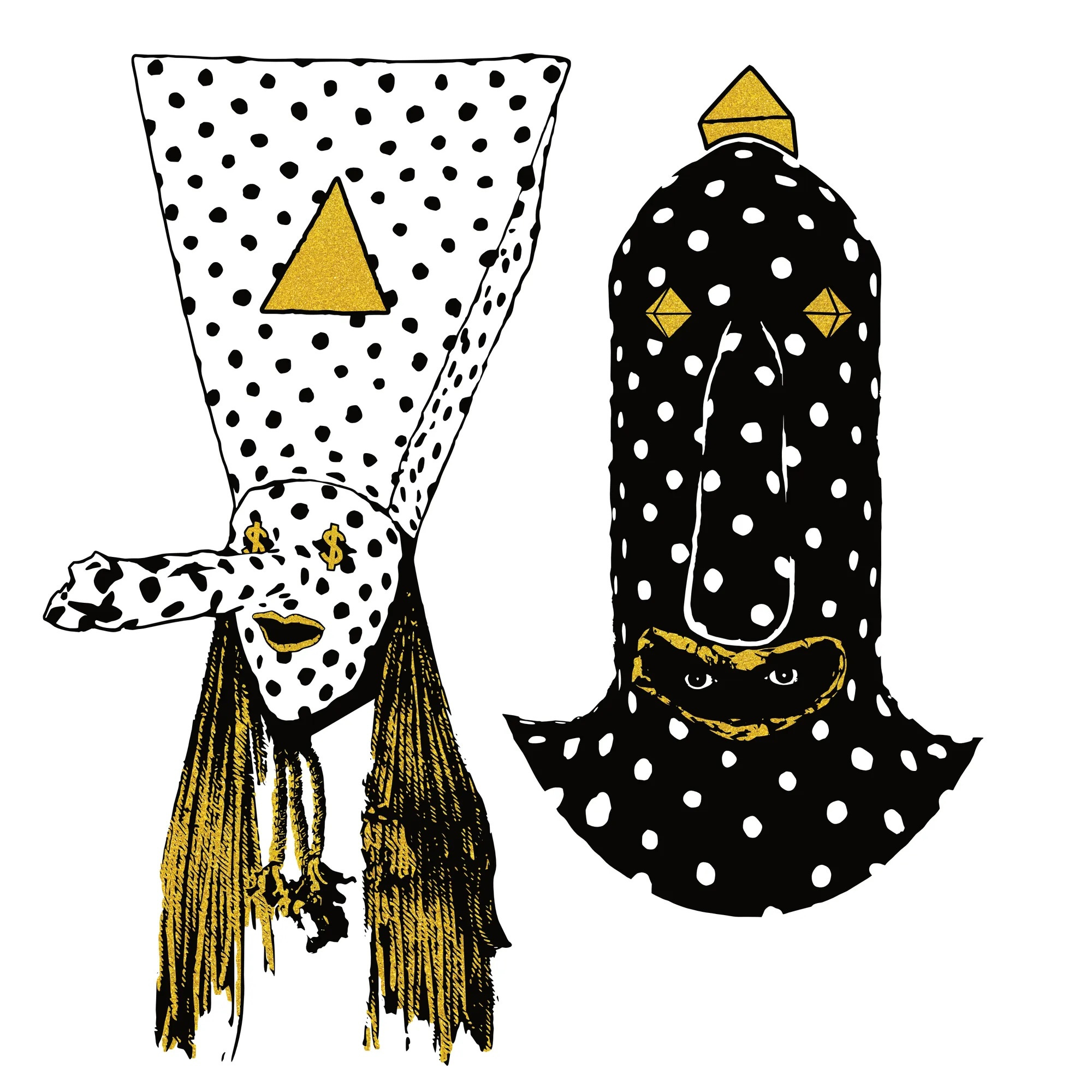
Angine de Poitrine’s anonymity is not presented as a puzzle. Their website discourages identity speculation outright. The masks are not an invitation to decode. They are a refusal.
What disappears with the face is biography. There is no origin story to anchor interpretation. No personal narrative to stabilize the work. Attention shifts to what remains: hands, timing, repetition, coordination. The labor becomes the subject.
One early account suggests the costumes began as a practical decision, a way to draw attention in a small venue. The meaning followed the gesture. Or perhaps it was always there. To hide the face while exposing the process is to invert the usual hierarchy of performance.
In a moment preoccupied with authorship, they remove the author.
The credits for their recent release list production and visual roles under playful variations of their names, alongside a straightforward acknowledgment of funding from the Canada Council for the Arts. The effect is both transparent and withholding. You are given the infrastructure but not the person. The invoice is visible. The face is not.
What it All Means
Angine de Poitrine is not outside the systems it appears to resist. Its rise depends on them. The same platforms that flatten music into clips delivered a performance that refuses to be clipped, and in doing so revealed a limit in how those systems are supposed to function.
What the moment clarifies is not that audiences have rejected technology, but that their relationship to it has shifted. The question of whether something was made by a human has become newly charged, and in that environment, work that foregrounds effort, coordination, and time begins to carry a different kind of weight.
This is not a new argument. It traces back at least to a small cabaret in Zürich, to performers who answered a rationalized world with deliberate, disciplined absurdity. The forms change, but the impulse remains recognizable.
For twenty-seven minutes, two figures in masks build a structure that does not resolve, does not simplify, and does not explain itself. Millions of people watch anyway.
Not in spite of the moment, but because of it.